
Design District, Dallas, Texas: Paintings for Interiors and the Trade
Northwest of downtown Dallas, between the Trinity River and Interstate 35, stands the one Dallas district built around looking. The Design District is where the city shops for its rooms. Furniture showrooms, fabric houses, lighting showrooms, stone yards, antique shops, and art galleries fill its low warehouse streets. Interior designers work here daily, moving from building to building with samples and plans. This page is a guide to that district, to its museum, its gallery street, and its warehouse history, and to my paintings made for the interiors this trade creates.
I am Bartosz Beda, an abstract figurative artist based in Dallas. I paint figures that emerge from paint and partly dissolve back into it. In a district where every object is chosen for a room, a painting has to earn its wall. It has to hold a room at full size, in real light, next to real materials. That test is the subject of this page.
The Design District in my record
The honest version comes first. I have no exhibition in the Design District to report. No gallery on Dragon Street has shown my work, and no showroom here represents me. This page does not invent a show, a representation, or a placement that did not happen.
What is true is the audience. Interior designers are a real audience for my paintings. In October 2026 my Mirage catalog went to interior designers as part of my outreach to the design trade. That is the connection stated at its true level: the people who furnish and finish rooms in this district are among the readers my work already reaches, and this page speaks to them directly.
My Dallas exhibition record sits nearby, outside the district. I held solo exhibitions at Ro2 Art in Dallas, including Two Minutes Before Midnight in 2022 and Owing to the Absence in 2023, and I completed a residency with Ro2 Art from November 2022 to January 2023. The Dallas page on this site holds that record in full. This page exists for a different reason. It marks the ground where Dallas decides what goes on its walls, and it puts my paintings in front of the trade that makes those decisions.
Dallas Contemporary
The district has one museum, and it is a working model of the district itself: a former industrial building turned into rooms for art. Dallas Contemporary stands at 161 Glass Street, Dallas, Texas 75207. It is a non-collecting arts space, a kunsthalle in the European sense. It owns no permanent collection. Its galleries turn over with each new exhibition, and admission is always free.
The institution began in 1978. Patricia Meadows founded it as an artists organization, first known as D-Art, and it later carried the names Dallas Visual Art Center and Dallas Center for Contemporary Art before taking its present name. For about thirty years it worked from Swiss Avenue, where it hosted annual member exhibitions and offered space to emerging artists.
In 2010 the museum relocated to the Design District. Its new home was a 37,000 square foot industrial building on Glass Street, used as a metal workshop and a manufacturer of sprinkler systems. Architect Edward Baum redesigned the building for the museum. The first phase opened in January 2010 with an exhibition by the Los Angeles based artist James Gilbert. Raw warehouse space became white gallery space, but the building kept its industrial scale, and that scale is the point. Large work needs large rooms, and this museum gives contemporary art rooms built to a warehouse measure.
The museum is open Thursday to Sunday, 11 AM to 5 PM, and admission is free. Its program mixes regional, national, and international artists, with exhibitions, performances, publications, and learning programs, including artist talks. For a first visit, start here. The map on this page centers on the museum. Its galleries teach how the district thinks: old industrial ground, new work, and nothing kept from another century.
Showrooms and Dragon Street: the trade at work
The district began as a place for the trade only, and the trade still sets its rhythm. On weekdays the streets fill with designers, architects, dealers, and installers. Vans load furniture. Crates move. Samples change hands. Many showrooms historically sold only through designers, and some still work that way, while others now open their doors to the public as well.
Two anchors explain the showroom side. The Decorative Center Dallas, on Oak Lawn Avenue at Hi Line Drive, was developed by Trammell Crow in the mid 1950s, inspired by the Chicago Merchandise Mart. Its seven acre courtyard plan gathered decorating showrooms around landscaped parking courts, with a Modernist arcade linking the storefronts. It gave Dallas decorators one address instead of a scattered city. A short drive north, the Dallas Design Center at 1025 North Stemmons Freeway houses showrooms in one large building on the corridor. Designers still give that Stemmons address the way other workers give a factory gate: it is where the day starts.
The gallery side gathers on and around Dragon Street. Art galleries have been migrating to Dragon Street for nearly a decade, and the district’s own guide calls the area the epicenter of the gallery scene in the city. Gallery addresses fill the 1100, 1200, and 1300 blocks of Dragon Street, mixed with working studios and design shops. Slocum Street, one block east, is known for its antique shops, and Howell Street nearby holds vintage shops. The pattern matters for a painter. On Dragon Street, art is not an event that happens four times a year. It is stock, shown daily, in rooms built for trade buyers who look at paintings the way they look at a chair or a textile: closely, critically, and with a client’s wall already in mind.
That daily looking is why Design District Dallas art deserves a page of its own on this site. A painting placed through this district enters a home, a hotel, an office, or a restaurant because a professional chose it on a working day. My work is offered in that same spirit: through the series pages on this site and through my online store, with no gallery between the painter and the person who will live with the painting.
A short history of the district
The district stands on river ground. Before it was a design quarter, it was the low floodplain of the Trinity River, northwest of the young downtown. The great flood of 1908 spread the river more than a mile wide and covered parts of this ground and of downtown. Dallas answered with engineering. The city built levees, moved the river channel into a managed floodway, and turned risky bottomland into usable industrial land.
Developer Trammell Crow read that new land early. From the late 1940s through the 1950s he built warehouses on it, and other builders followed. The ground was cheap, the lots were large, and downtown was minutes away. In the early 1950s the first showrooms and warehouses rose here as a plain working quarter along the river banks. Crow’s Decorative Center, opened in the mid 1950s, showed what the quarter could become: a home trade center where decorators and furniture salesmen could gather in one place.
Access sealed the district’s future. Interstate 35 and the Stemmons Freeway corridor, built along the district’s northeast edge in the following decade, tied the warehouses to the whole region. The Dallas Market Center grew up on Stemmons just north of the district, and its Interior Home and Design Center building, first opened in 1957, still serves the design trade on the same corridor. Showroom by showroom, the warehouse quarter became the city’s design address, while the long warehouse buildings stayed. Their deep floors, high ceilings, and plain brick faces are now the district’s character.
The river edge gives the district its second face. West of the showrooms, the levees still hold the Trinity floodway, and the Margaret Hunt Hill Bridge crosses it in a single white arch. The bridge was designed by Santiago Calatrava and opened to traffic on March 29, 2012. It carries Woodall Rodgers Freeway from downtown to Singleton Boulevard in West Dallas. Its 400 foot arch is visible from the district’s western streets. A district built by warehouses gained, late, a monument, and the monument is a piece of engineering that behaves like a drawing in the sky.
Mirage: paintings read the way designers read a room
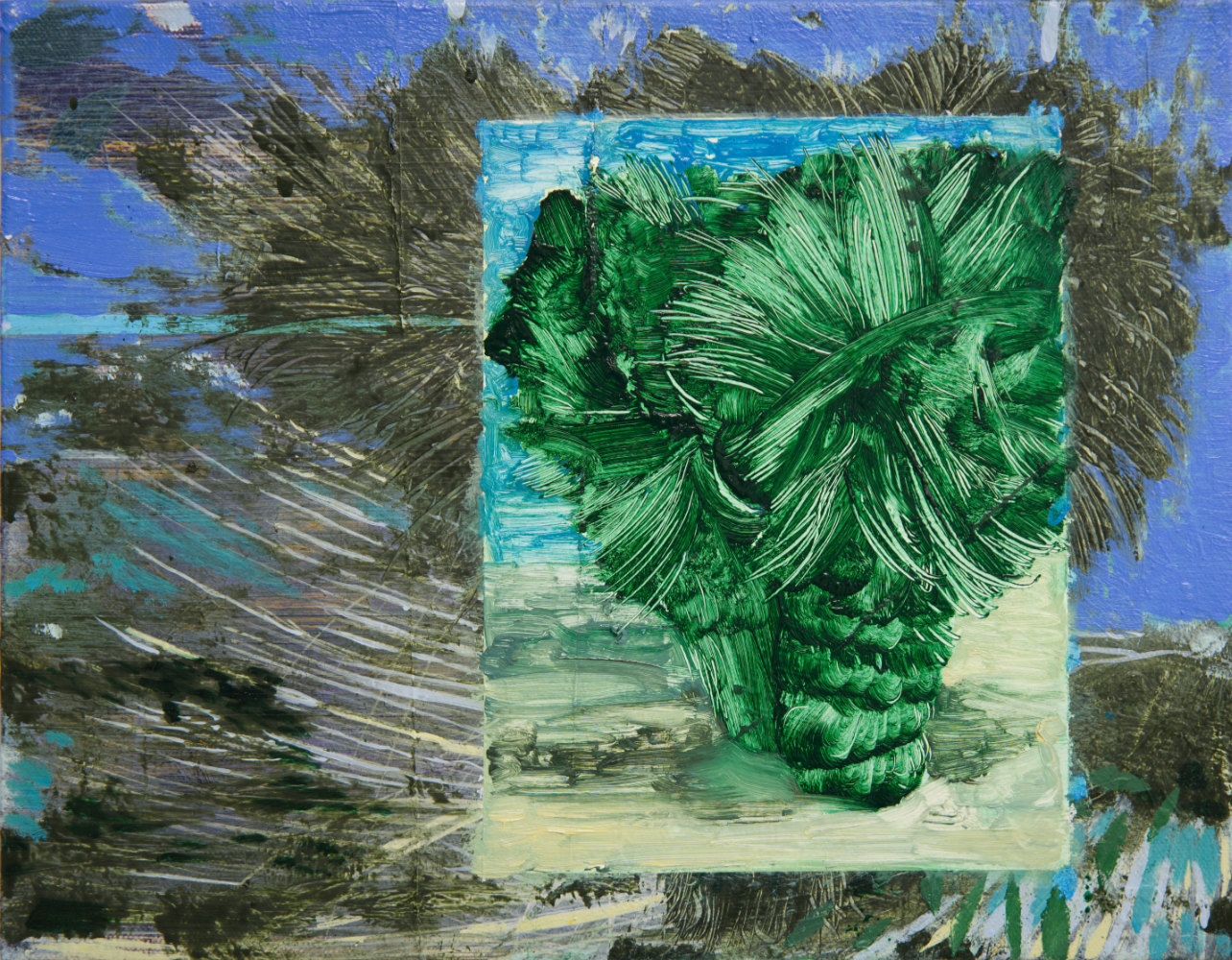
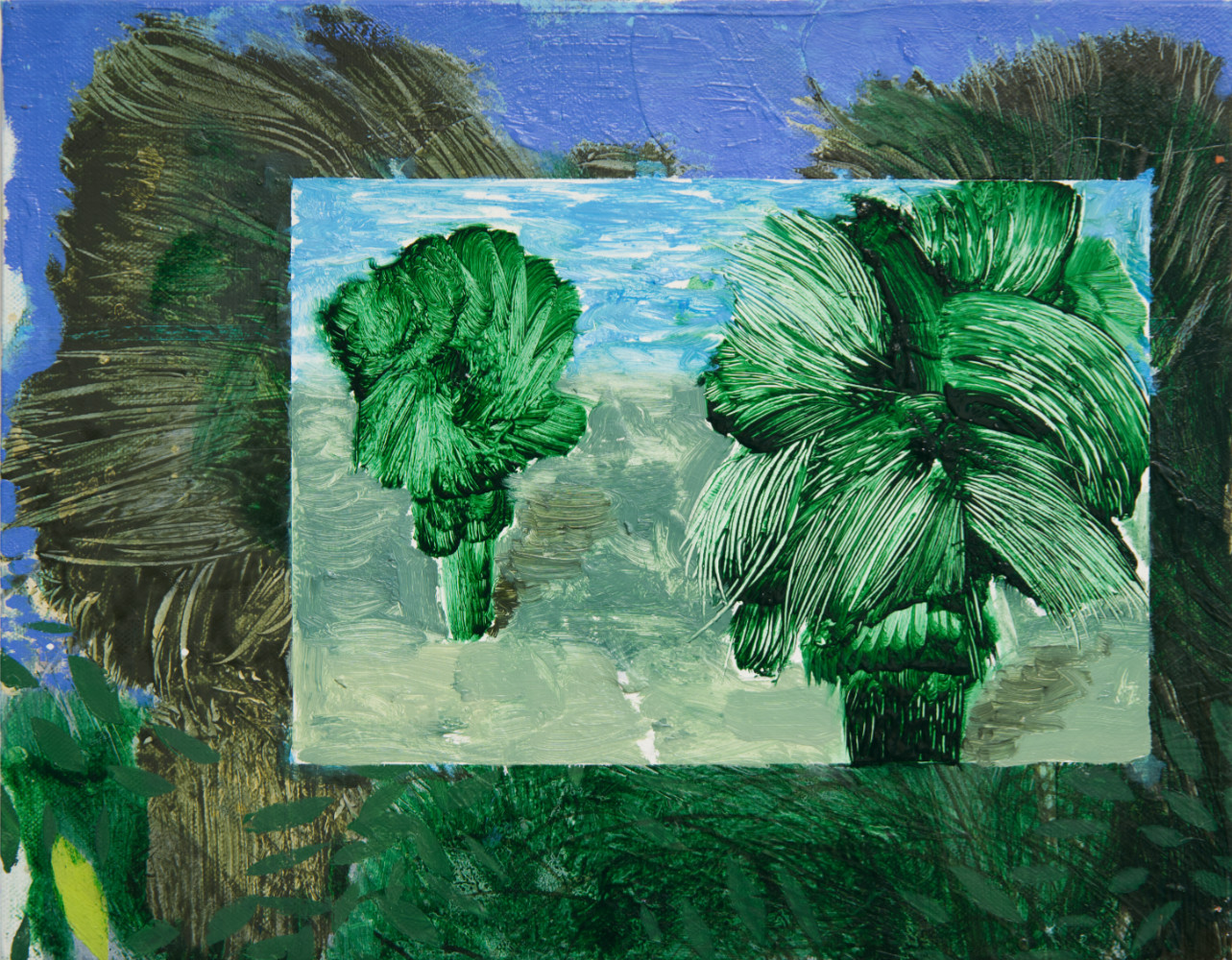
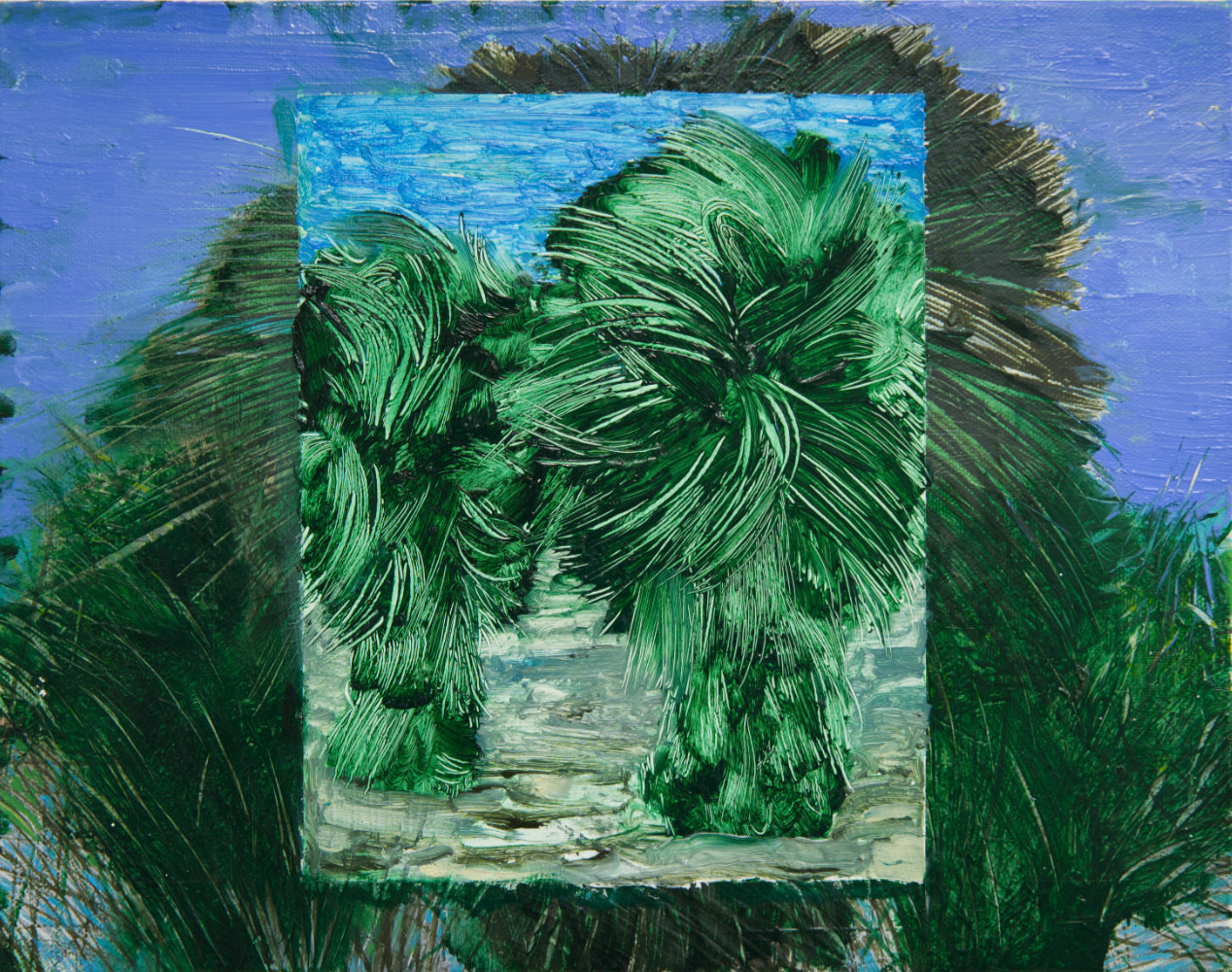
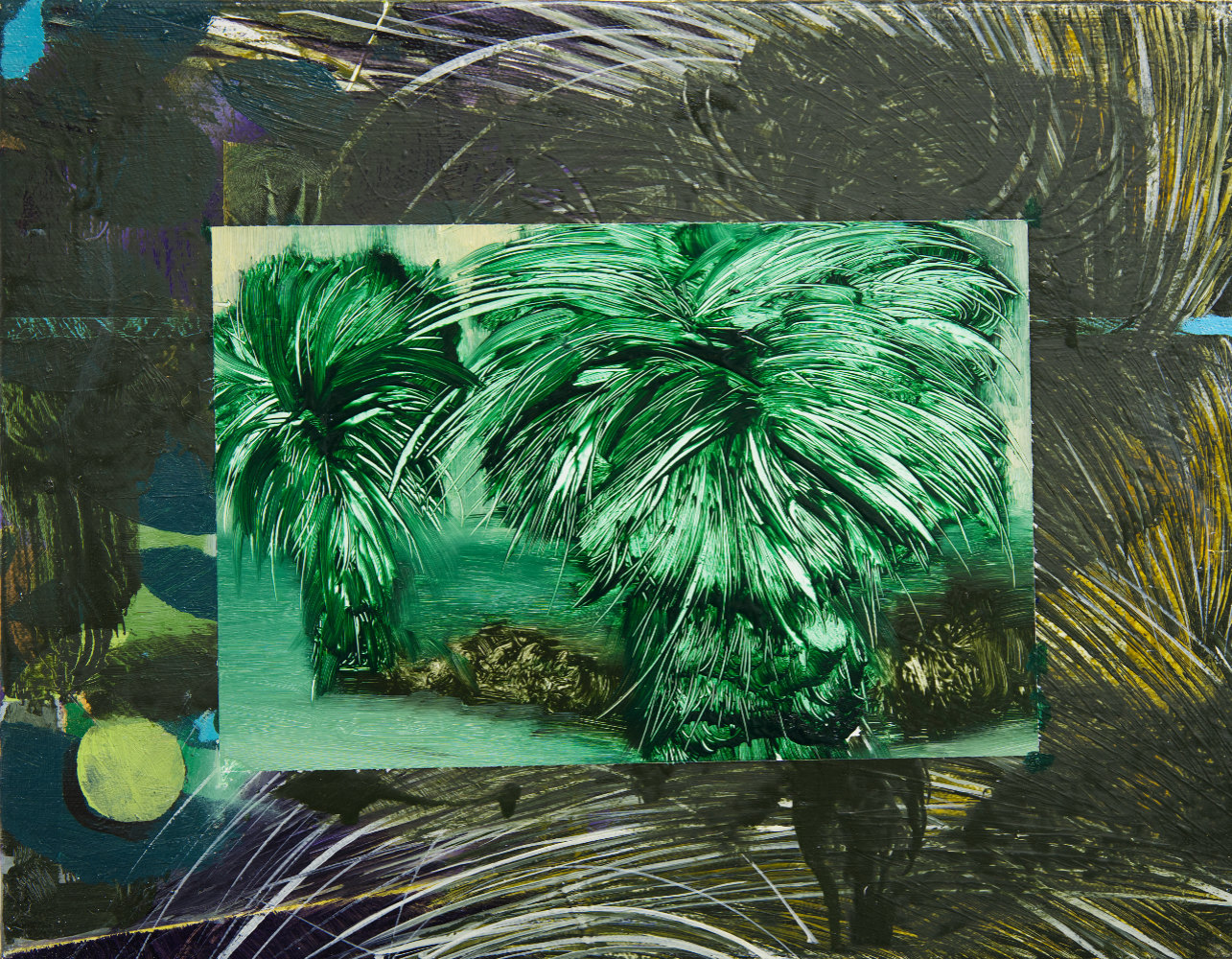
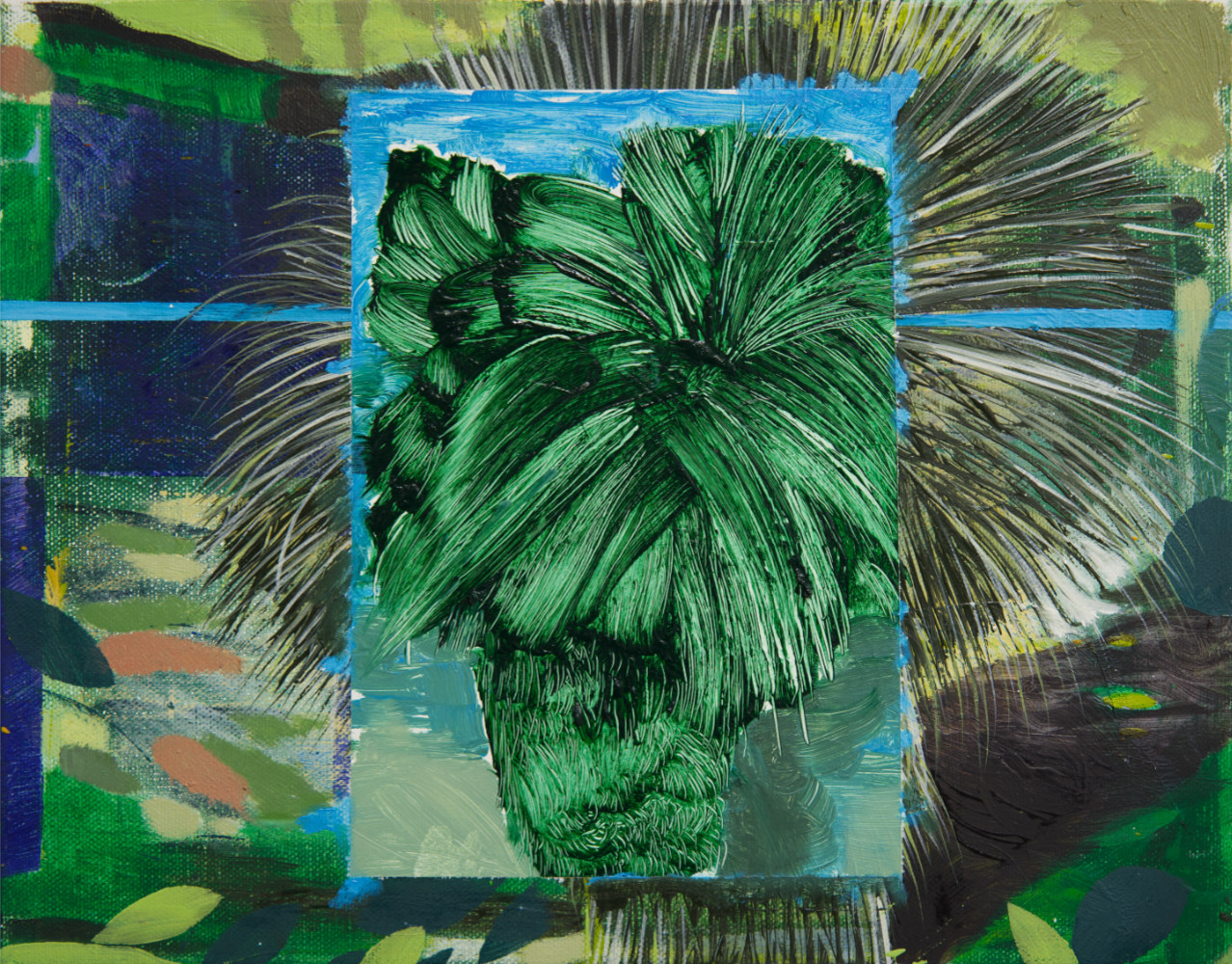
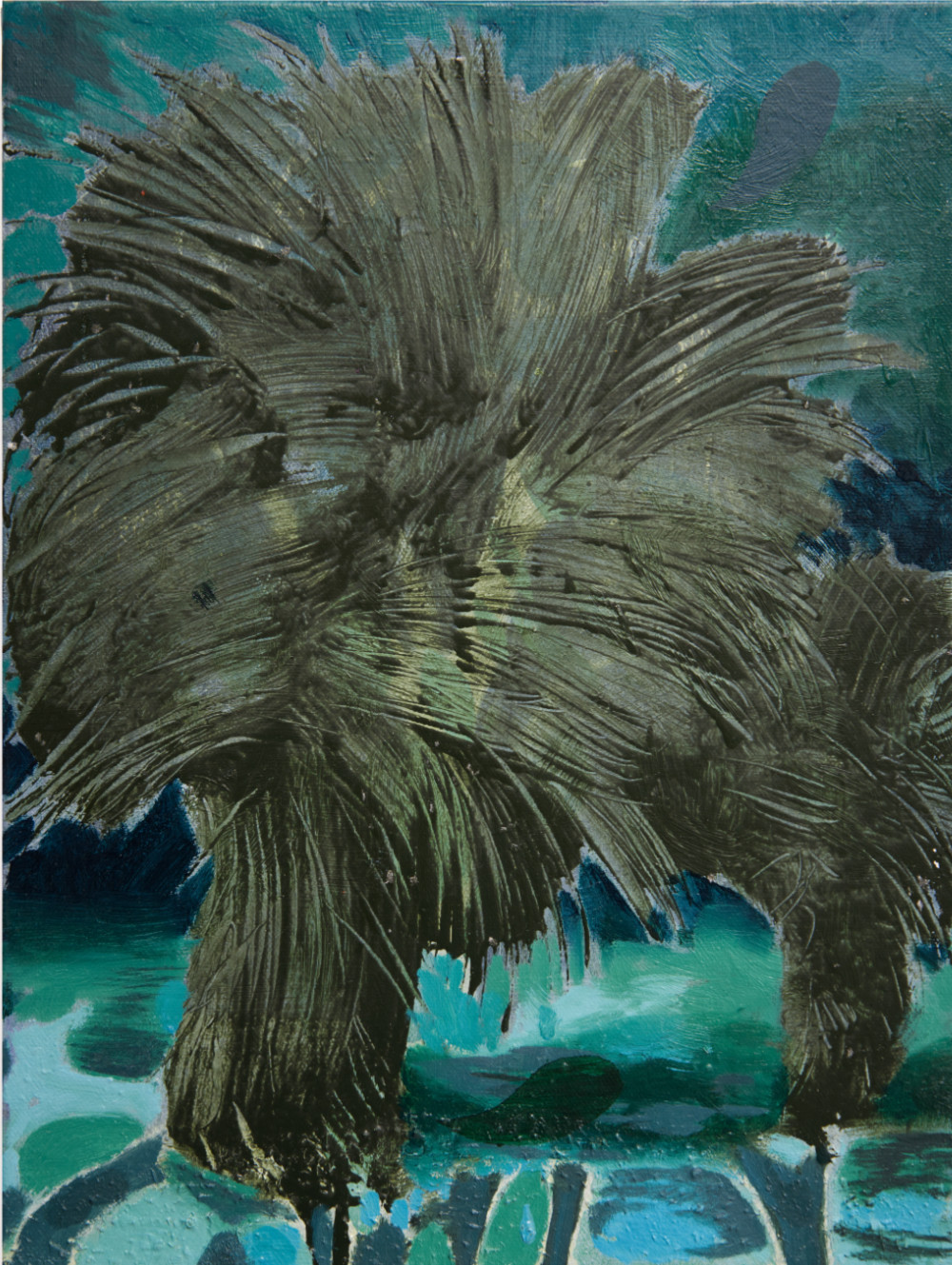
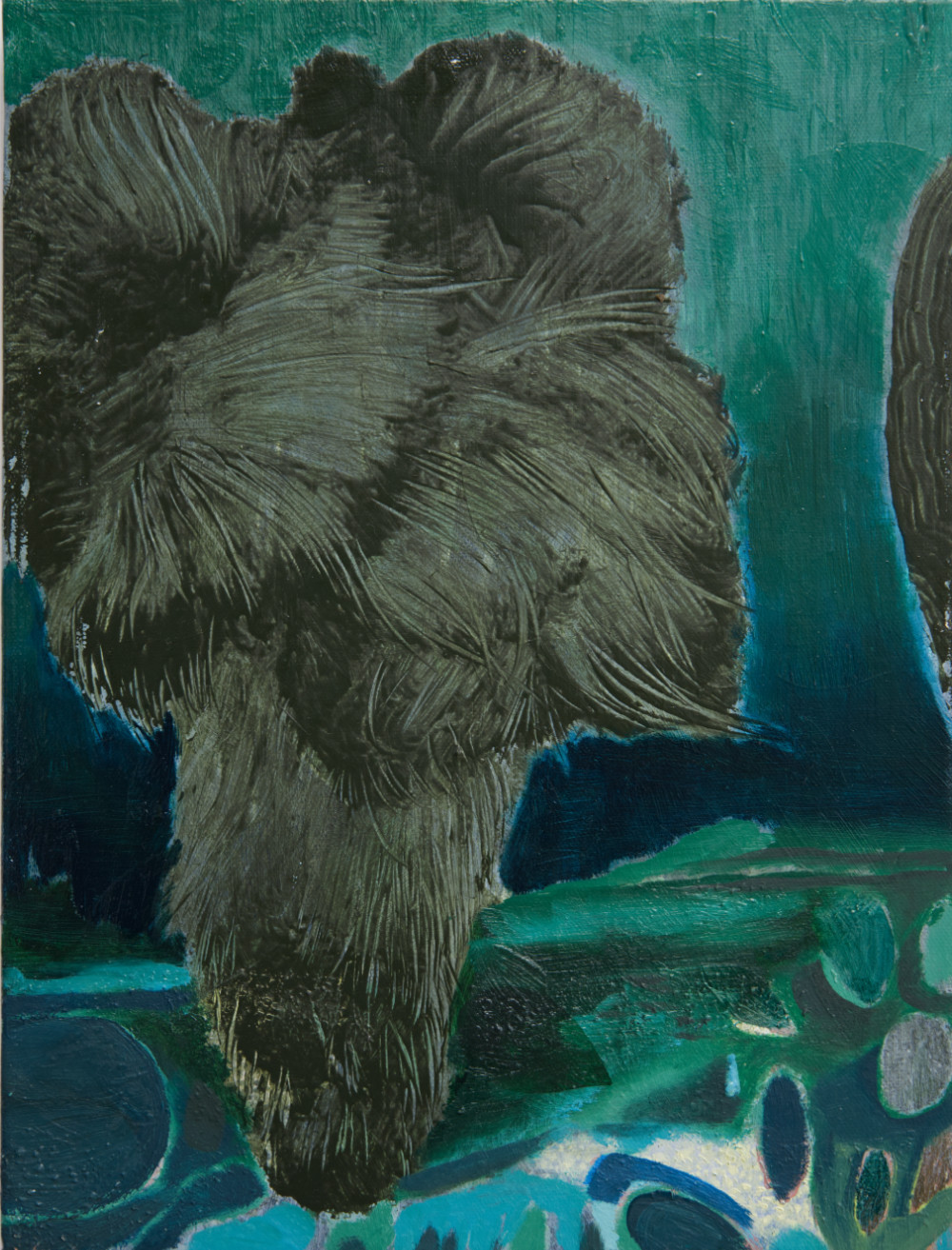
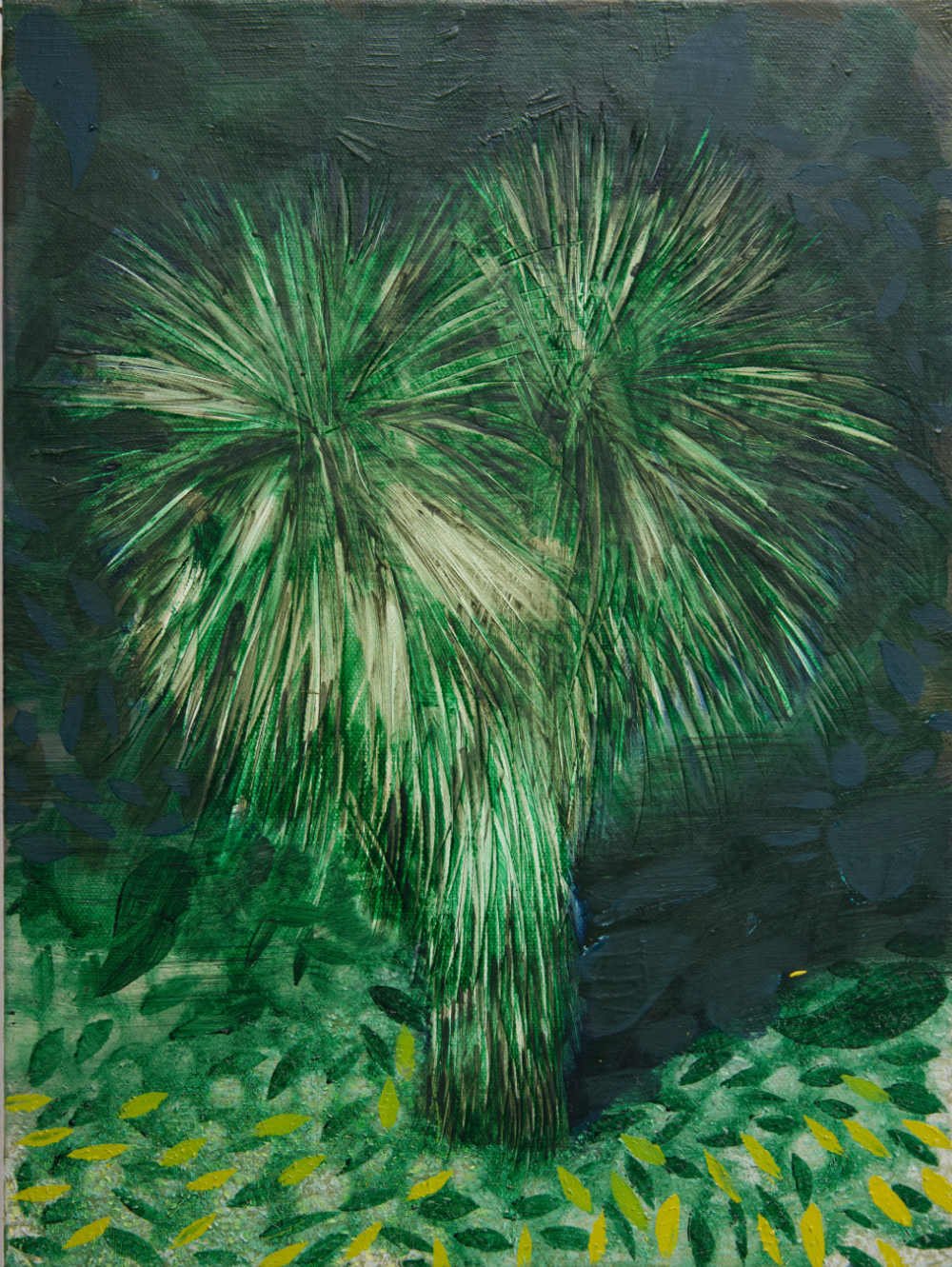
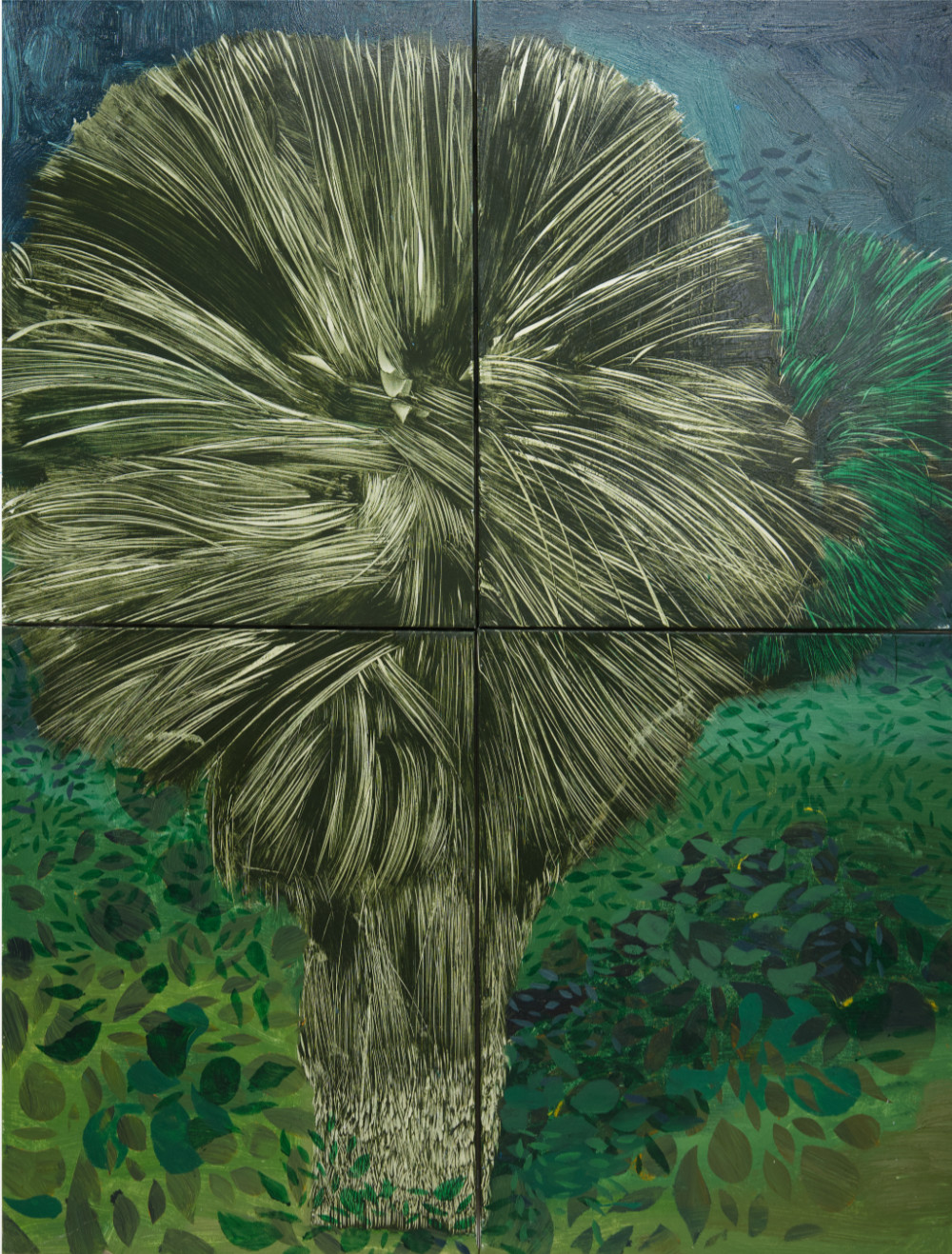
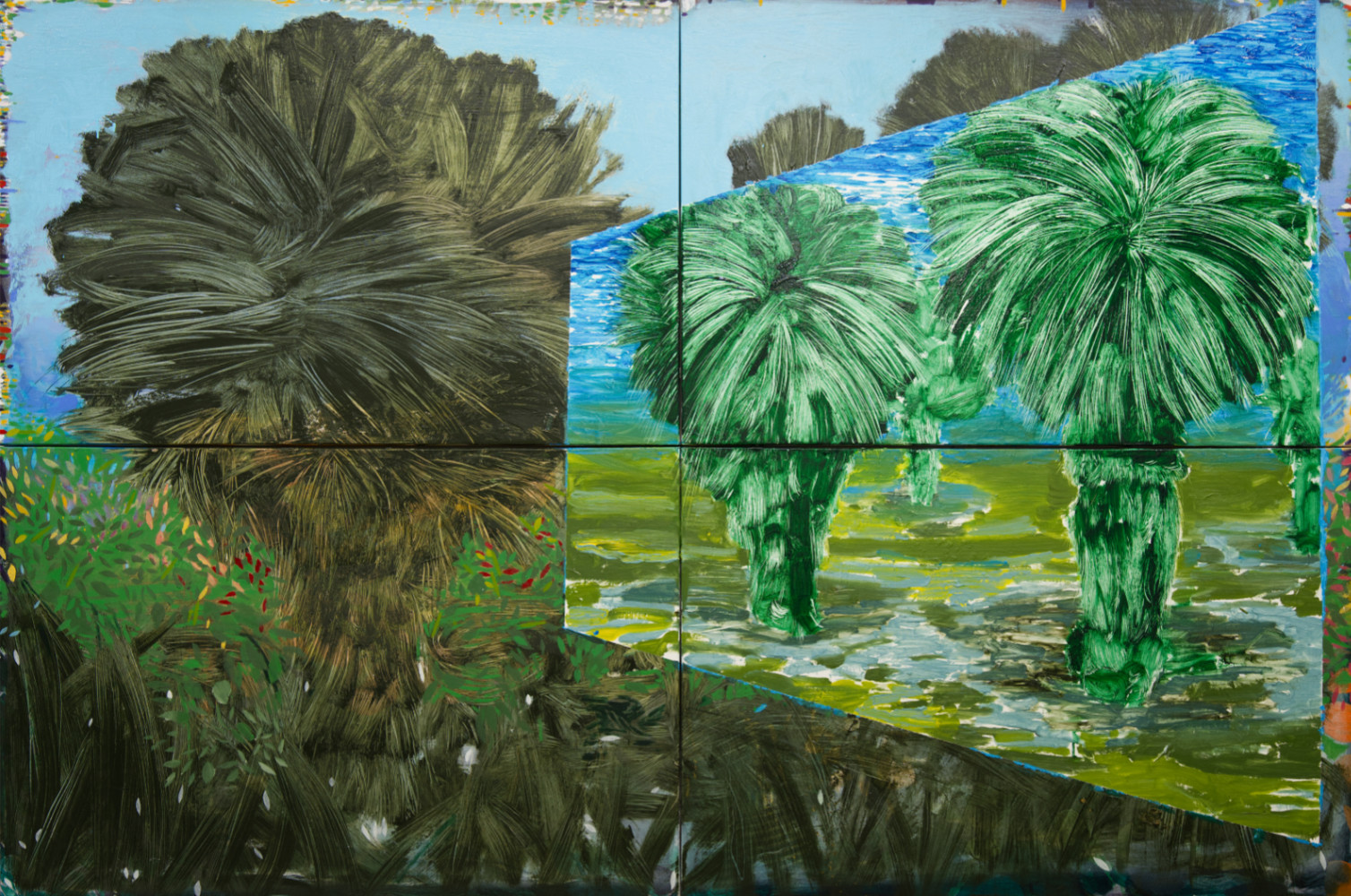
Mirage is the series I bring to this district, because Mirage was always about how a familiar form changes when the light and the setting change. The series began during my residency in San Angelo, in West Texas. On night walks I passed beaked yuccas along the paths. Under lamps their color drained away. The blades stiffened into pale fans, and the plants read less like planting and more like watchers at the edge of the path. In the studio I worked from photographs of those nights, cut handmade stencils from the shapes, and let the yucca open into a form that hovers between plant, land, and body.
That hovering is my ground as an abstract figurative artist. Mirage is abstract figurative art where the figure is carried by a landscape form instead of a human body. A canvas can feel solid from across a room and unstable up close. Edges hold, then loosen. A dark ground lets a pale shape glow the way the yuccas glowed, lit from one side and lost on the other. The paintings keep the uncertainty of seeing something at night, when the eye is sure of a presence and unsure of its outline.
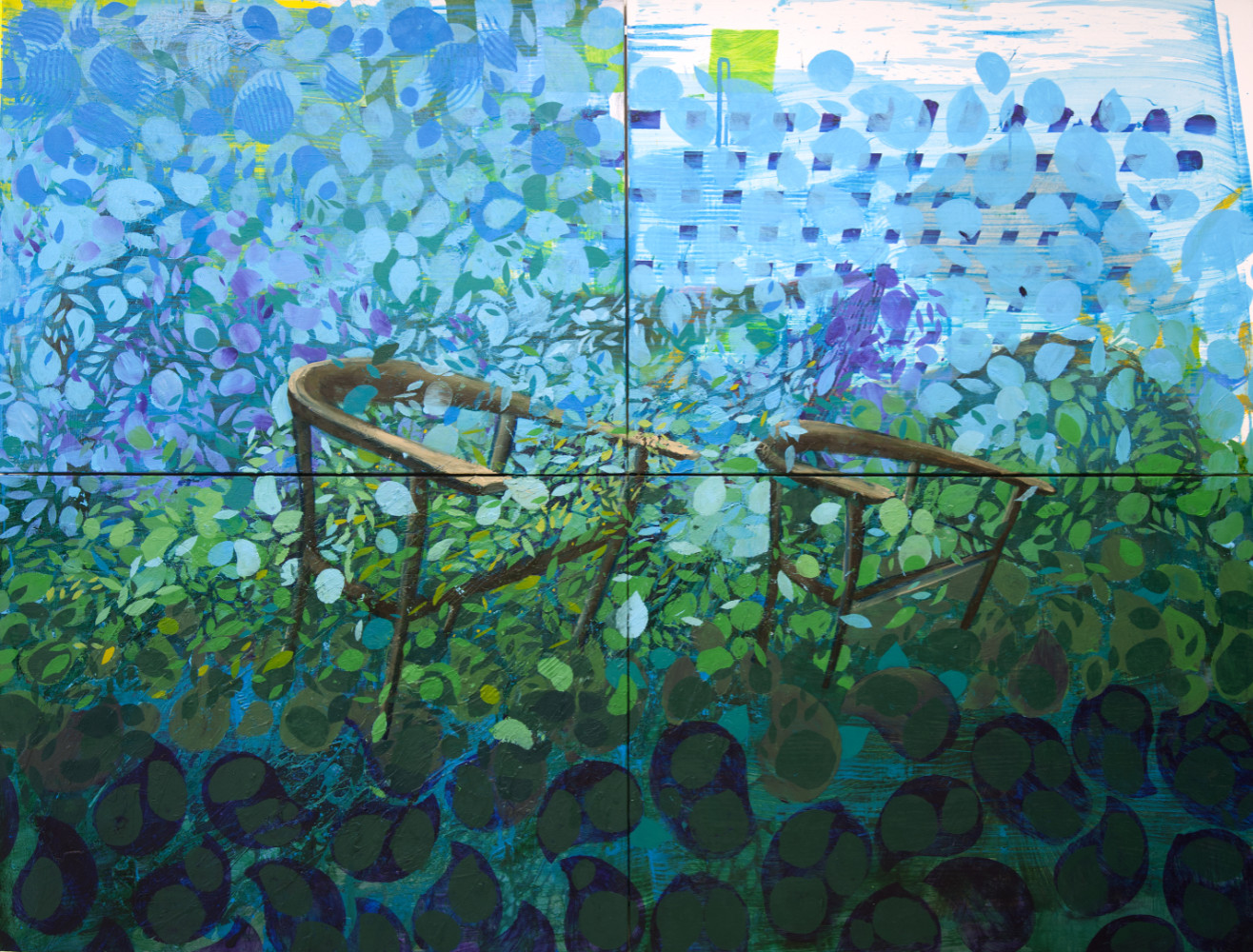
Designers read paintings in a practical order: scale first, then palette, then surface, then subject. Mirage was painted to survive that order. The large canvases carry a wall the way a rug carries a floor, by giving the room one strong field to organize around. The smaller canvases work in pairs and groups, where rhythm matters more than size. The palette is restrained, built on dark grounds and washed light, so the work sits with stone, wood, linen, and leather without fighting them. The surface is visibly handmade, with stencil edges and brushed passages that reward close looking.
For trade readers, one more quality matters. These are original paintings in the Dallas Design District conversation, not prints of paintings and not copies of a style. Each canvas is one object, made in my studio, and it enters a project the way a custom piece of furniture does: chosen for one room, at one scale, for one client. Design District Dallas art, at its best, works exactly like that.
Visiting, and where the record continues
A useful visit takes half a day. Begin at Dallas Contemporary on Glass Street, where the map on this page is centered. Then walk the trade ground: Dragon Street for the galleries, Slocum Street for the antiques, and Oak Lawn Avenue and Hi Line Drive for the showroom courts around the Decorative Center. End at the river side if the light allows, and look west to the Margaret Hunt Hill Bridge over the floodway. You will have seen the district in its true order: museum, galleries, showrooms, warehouses, and river.
The record continues across this site. The Mirage series page holds the paintings in full. The online store carries the current work. The Texas page gathers my statewide story in one arc, and the Dallas page carries my exhibition record in this city, including the Ro2 Art solos and residency. The formal lines are on my CV page, and all the town and district pages of this site meet on the Market page. The Design District has no wall of mine yet. It has the trade, the museum, and the rooms. This page is my introduction to all three.
Frequently Asked Questions
Has Bartosz Beda exhibited in the Dallas Design District?
I have no exhibition in the Design District to report. No gallery on Dragon Street has shown my work, and no showroom here represents me. What is true is the audience. Interior designers are a real audience for my paintings, and in October 2026 my Mirage catalog went to interior designers as part of my outreach to the design trade. My Dallas exhibition record sits nearby, outside the district: solo exhibitions at Ro2 Art and a residency with Ro2 Art from November 2022 to January 2023.
What is Dallas Contemporary?
Dallas Contemporary stands at 161 Glass Street. It is a non-collecting arts space, a kunsthalle in the European sense. It owns no permanent collection. Its galleries turn over with each new exhibition, and admission is always free. The museum is open Thursday to Sunday, 11 AM to 5 PM, and its program mixes regional, national, and international artists.
How did Dallas Contemporary begin?
The institution began in 1978. Patricia Meadows founded it as an artists organization, first known as D-Art, and it later carried the names Dallas Visual Art Center and Dallas Center for Contemporary Art before taking its present name. For about thirty years it worked from Swiss Avenue, where it hosted annual member exhibitions and offered space to emerging artists.
When did Dallas Contemporary move to the Design District?
In 2010 the museum relocated to the Design District. Its new home was a 37,000 square foot industrial building on Glass Street, used as a metal workshop and a manufacturer of sprinkler systems. Architect Edward Baum redesigned the building for the museum, and the first phase opened in January 2010 with an exhibition by the Los Angeles based artist James Gilbert. The building kept its industrial scale, and that scale is the point.
What is the Decorative Center Dallas?
The Decorative Center Dallas, on Oak Lawn Avenue at Hi Line Drive, was developed by Trammell Crow in the mid 1950s, inspired by the Chicago Merchandise Mart. Its seven acre courtyard plan gathered decorating showrooms around landscaped parking courts, with a Modernist arcade linking the storefronts. It gave Dallas decorators one address instead of a scattered city.
What is Dragon Street known for in Dallas?
Dragon Street is the district’s gallery street. Art galleries have been migrating to Dragon Street for nearly a decade, and the district’s own guide calls the area the epicenter of the gallery scene in the city. Gallery addresses fill the 1100, 1200, and 1300 blocks, mixed with working studios and design shops. Slocum Street, one block east, is known for its antique shops.
What stood on the Design District’s ground before the showrooms?
The district stands on river ground: the low floodplain of the Trinity River. The great flood of 1908 spread the river more than a mile wide and covered parts of this ground and of downtown. Dallas answered with levees and a managed floodway, and developer Trammell Crow built warehouses on the new land from the late 1940s. The first showrooms and warehouses rose in the early 1950s, and showroom by showroom the warehouse quarter became the city’s design address.
What is the Margaret Hunt Hill Bridge?
West of the showrooms, the Margaret Hunt Hill Bridge crosses the Trinity floodway in a single white arch. The bridge was designed by Santiago Calatrava and opened to traffic on March 29, 2012. It carries Woodall Rodgers Freeway from downtown to Singleton Boulevard in West Dallas, and its 400 foot arch is visible from the district’s western streets.
How do interior designers read a painting?
Designers read paintings in a practical order: scale first, then palette, then surface, then subject. Mirage was painted to survive that order. The large canvases carry a wall the way a rug carries a floor, by giving the room one strong field to organize around. The palette is restrained, built on dark grounds and washed light, so the work sits with stone, wood, linen, and leather without fighting them.
What is the Dallas Design Center?
The Dallas Design Center stands at 1025 North Stemmons Freeway and houses showrooms in one large building on the corridor. Designers still give that Stemmons address the way other workers give a factory gate: it is where the day starts. Many showrooms in the district historically sold only through designers, and some still work that way, while others now open their doors to the public as well.