
Jersey Village, Texas: New Figure Paintings in the City a Dairy Named
Jersey Village is a small city in west central Harris County, in the middle of the Houston metroplex. It covers about three and a half square miles. It has its own mayor, its own council, its own police department, and its own fire department. Houston surrounds it on every side, and Houston never absorbed it. The reason is a date. Jersey Village incorporated in 1956, before the big city could annex the ground. What began as one man’s dairy farm became a city on purpose, and it has stayed a city ever since.
I am Bartosz Beda, an abstract figurative artist. I paint the human figure under pressure: built up, broken down, and rebuilt in paint. This page is my guide to Jersey Village, to the dairy farm that named it, to the lake and the golf course the founders set aside, and to my newest series of figure paintings, Apogee, offered to the people who live in its houses.
Jersey Village in my record
The honest version is short. I have no exhibition in Jersey Village to report. No gallery here has shown my work, and this page does not invent one. Jersey Village has no gallery to show it in. It is a residential city, and this page treats it as one.
My Houston record sits southeast of here, in the museum district. I go to Houston to look: at the Museum of Fine Arts, at the Menil Collection, at the museum district rooms that set the standard for this whole region. That looking is part of my working life, and my Houston page on this site holds it in full. Jersey Village enters this site the way it enters the metroplex. It is a small, complete city that kept its own shape while a much larger city grew around it. Paintings belong in such a place the way they belong anywhere people stay: on the walls of houses that hold lives.
The dairy farm ground
Before it was a city, this ground was a dairy. Clark W. Henry owned 1,236 acres here. On that land he operated F&M Dairy and raised Jersey cattle. The 1936 Harris County highway map already showed several residences in the area, but the working heart of the place was the farm: pasture, barns, and a herd of Jersey cows.
Jersey cattle are a small, hardy dairy breed, first bred on the island of Jersey in the English Channel. They give rich milk, and they suit a hot climate better than most dairy breeds. Henry’s choice of herd gave the future city more than milk. It gave it a name. The Handbook of Texas repeats the naming story with care: Henry ran the dairy, and the new development was named for his Jersey cows. Jersey Village is, in the plainest sense, the village of the Jersey herd.
The farm years ended with Henry’s health. As his health declined, he gave up the dairy, and the land was opened for a residential community. The change came in 1953 and 1954. Henry and LeRoy Kennedy, both members of the Garden Oaks Baptist Church, began developing the community in February 1954. The plan was drawn whole from the start. Space was set aside for homes, for a school, for a park, and for an eighteen hole golf course. At the center of the plan sat a small lake, Jersey Lake.
The lake still anchors the city. It is owned and maintained by a homeowners association, and residents whose homes stand on its shores, and their guests, can fish in it. A city that began as pasture kept water at its center, and the houses gathered around it. The golf course also stayed. Jersey Meadow Golf Course, the city’s municipal course, runs over the old farm ground. The site that once held a large herd of Jersey dairy cattle now holds fairways. The ground changed its crop. It stayed green.
A short history of Jersey Village
Building began in February 1954. The first ground held about five miles of streets, with drainage, gas, sewage, and water service laid in. The first houses rose along Jersey Drive. The first family moved into the subdivision in late October 1954. The community was barely a year old when it made the decision that fixed its future.
On April 16, 1956, Jersey Village incorporated. All 58 votes cast were in favor. The new city began with a volunteer police force. Incorporation mattered for one practical reason. Because Jersey Village was now a city of its own, Houston could not annex its territory. The village pattern was locked in while the land around it was still open. Houston grew to every edge of it, and stopped.
Growth was slow at first. In 1961 the city counted 493 residents. On July 6, 1972, Leonard Rauch gave Jersey Village a city hall building. That building later passed to the fire department and public works. A bond issue in 1977 built a new city hall, a city garage, a park pavilion, and an expansion of the fire department building. The population rose through the following decades: 4,084 in 1982, and 7,921 at the 2020 census.
In August 1986 the voters passed a home rule charter, 306 votes to 36. A home rule charter gave the city wider governing and taxing powers than it had held as a general law city. Jersey Village today runs under that charter, with a council and manager form of government. The mayor and five council members serve two year terms. The city manager runs the daily work.
The village today
Jersey Village sits at U.S. Highway 290 and Farm to Market Road 529, on the old Southern Pacific railroad line, in west central Harris County. Beltway 8, the Sam Houston Tollway, passes just west of the city. The freeway puts the whole metroplex within reach, and the city itself stays quiet behind it. A phrase used around the city is city close, country quiet. It fits. Downtown Houston is a freeway drive away. The streets at home are residential and still.
The city keeps its own services. The Jersey Village Police Department patrols its own streets. The Jersey Village Fire Department provides firefighting and emergency medical service to its residents. The City of Jersey Village posts its council agendas and services on its own site, and the council meets at the Civic Center on Lakeview Drive. These are small facts, but they are the facts of a real city. Jersey Village is not a subdivision with a borrowed address. Postal addresses here do read Houston, Texas. The government that answers the phone is Jersey Village’s own.
Its children attend the Cypress Fairbanks Independent School District. Post Elementary School stands inside the city. Jersey Village High School opened in 1972 and serves the city as well. Lone Star College serves the community for higher education. A park, the golf course, and the lake give the city its shared ground. For a painter, the interest of the place is its scale. This is a city small enough to know whole, three and a half square miles drawn once and held: farm, lake, streets, houses. It did not sprawl. It kept its drawing.
Apogee: a figure rising over flat ground
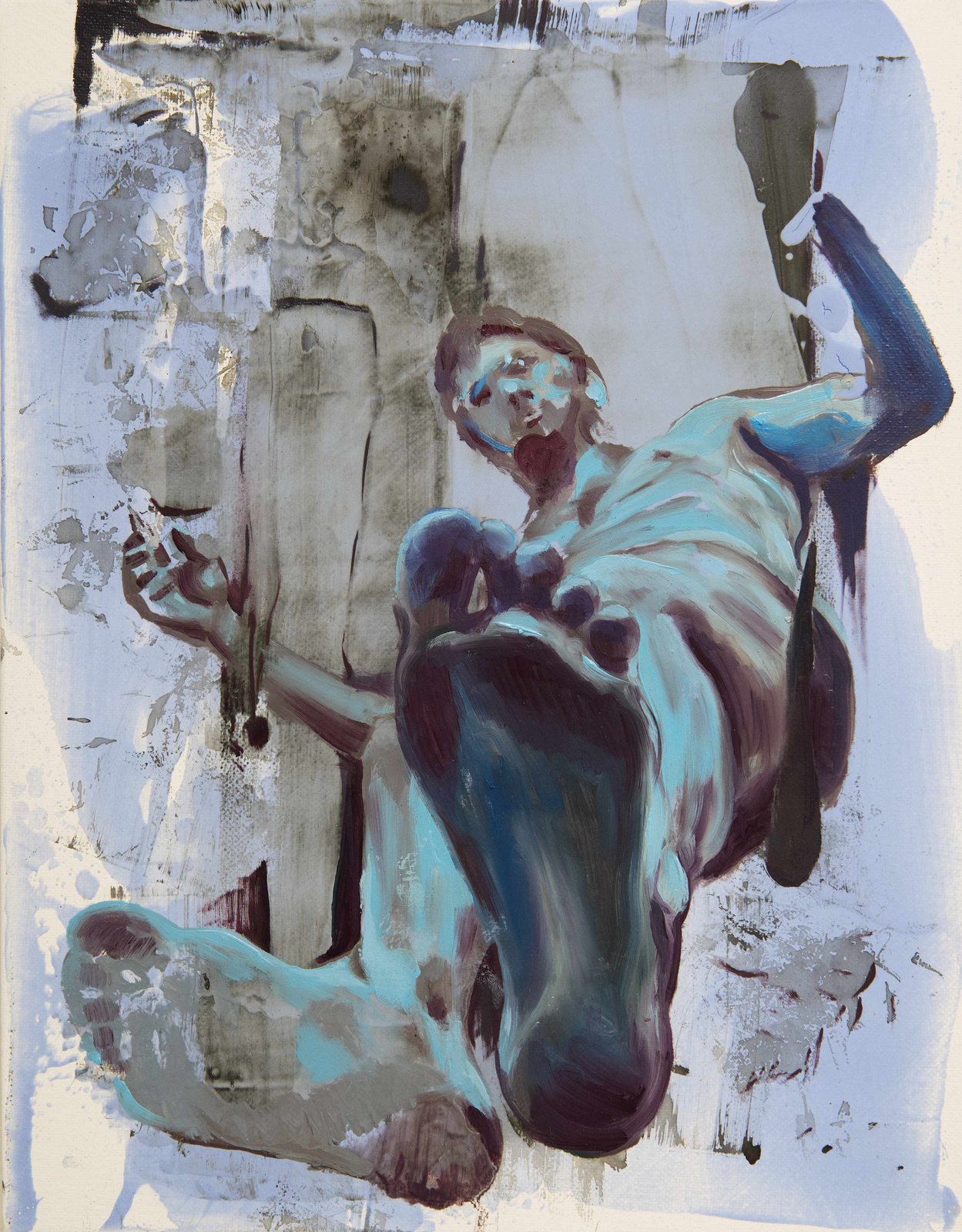
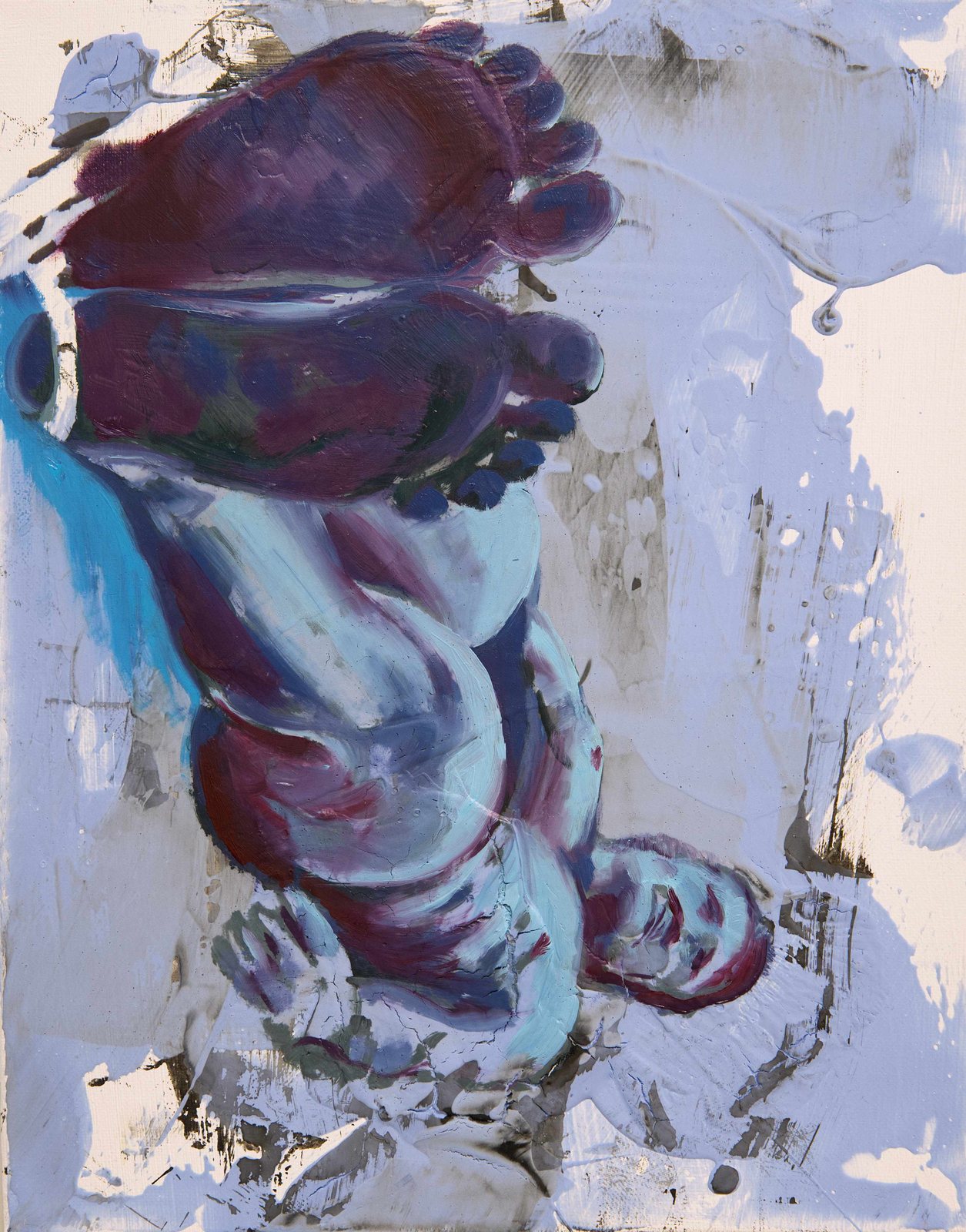
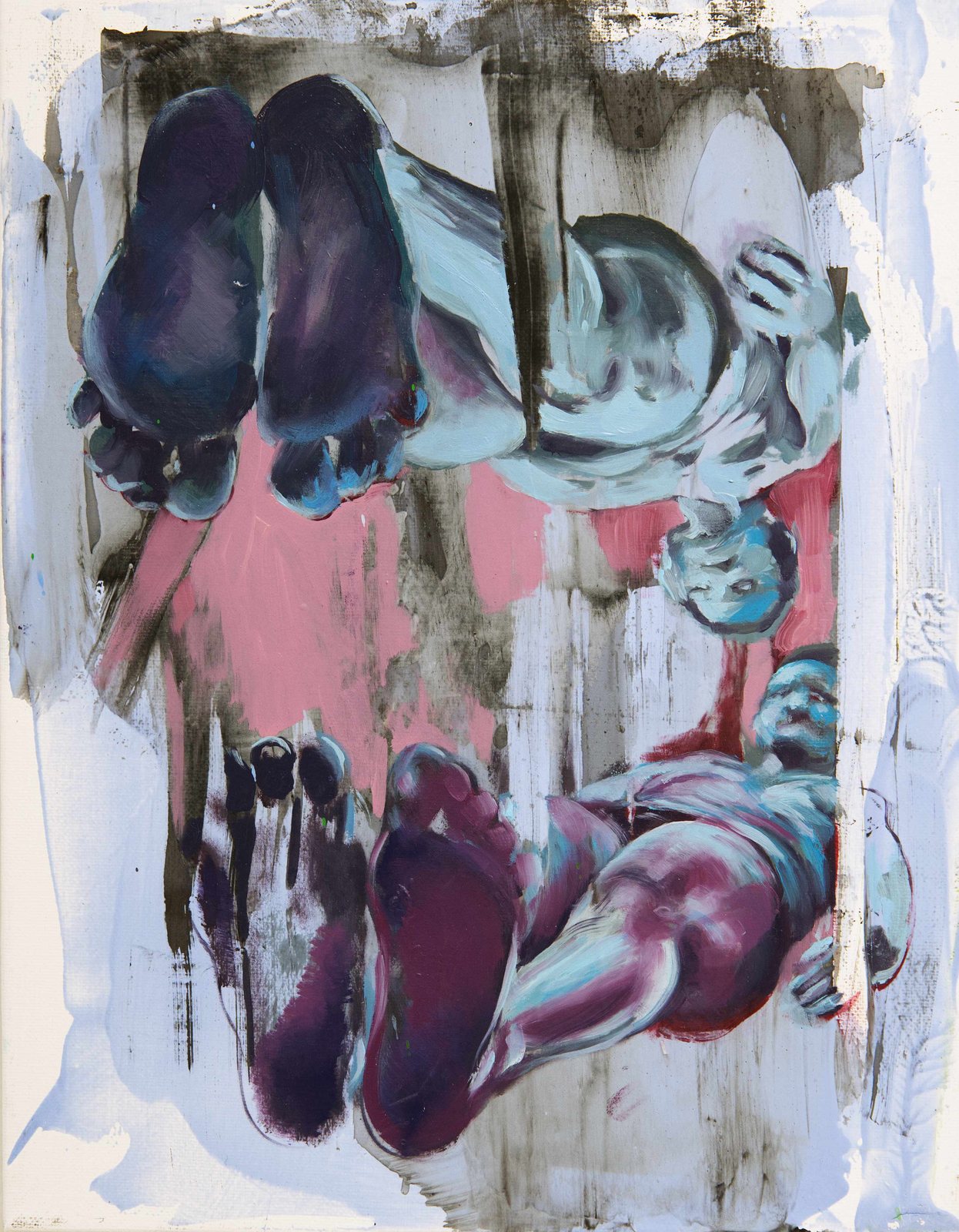
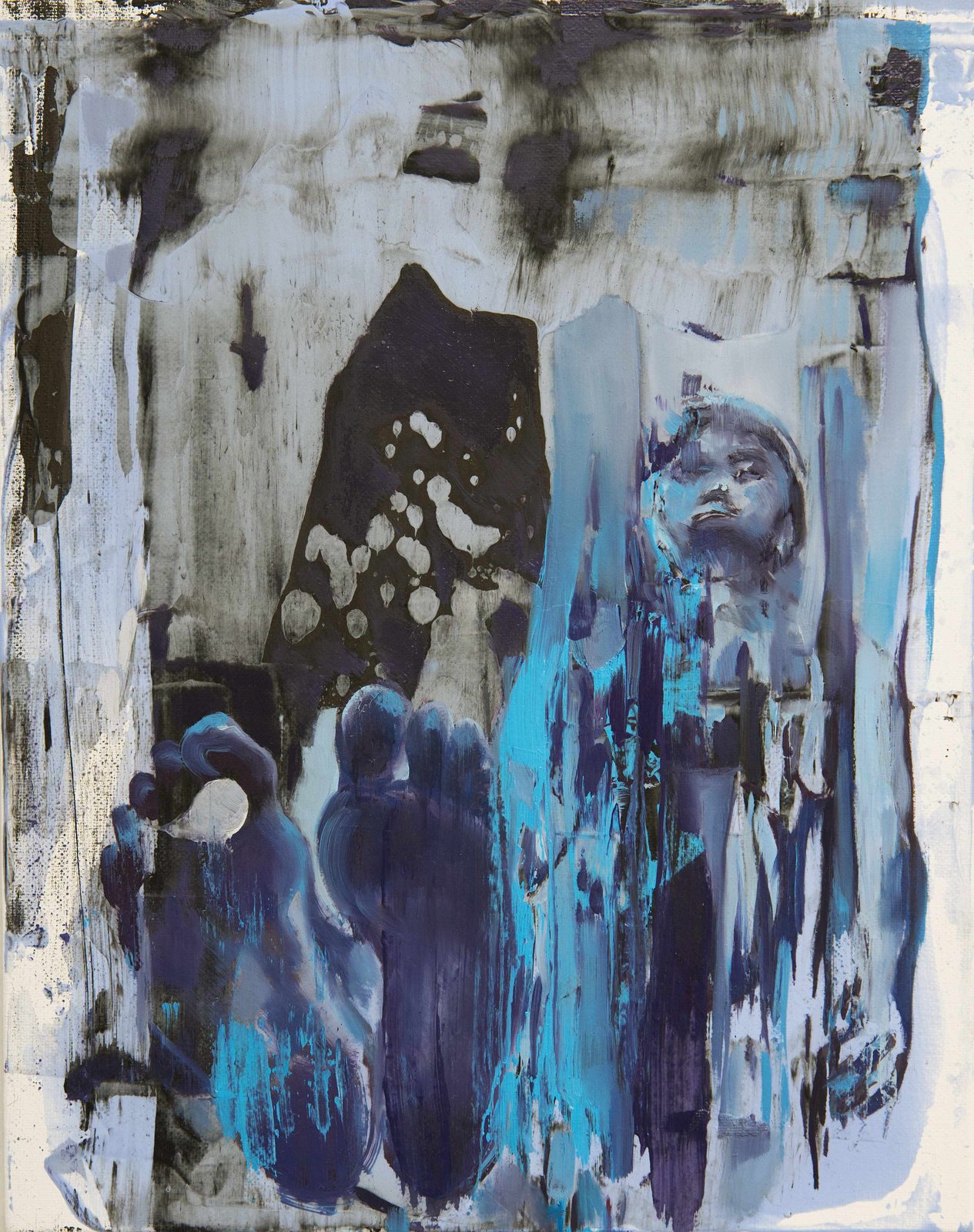
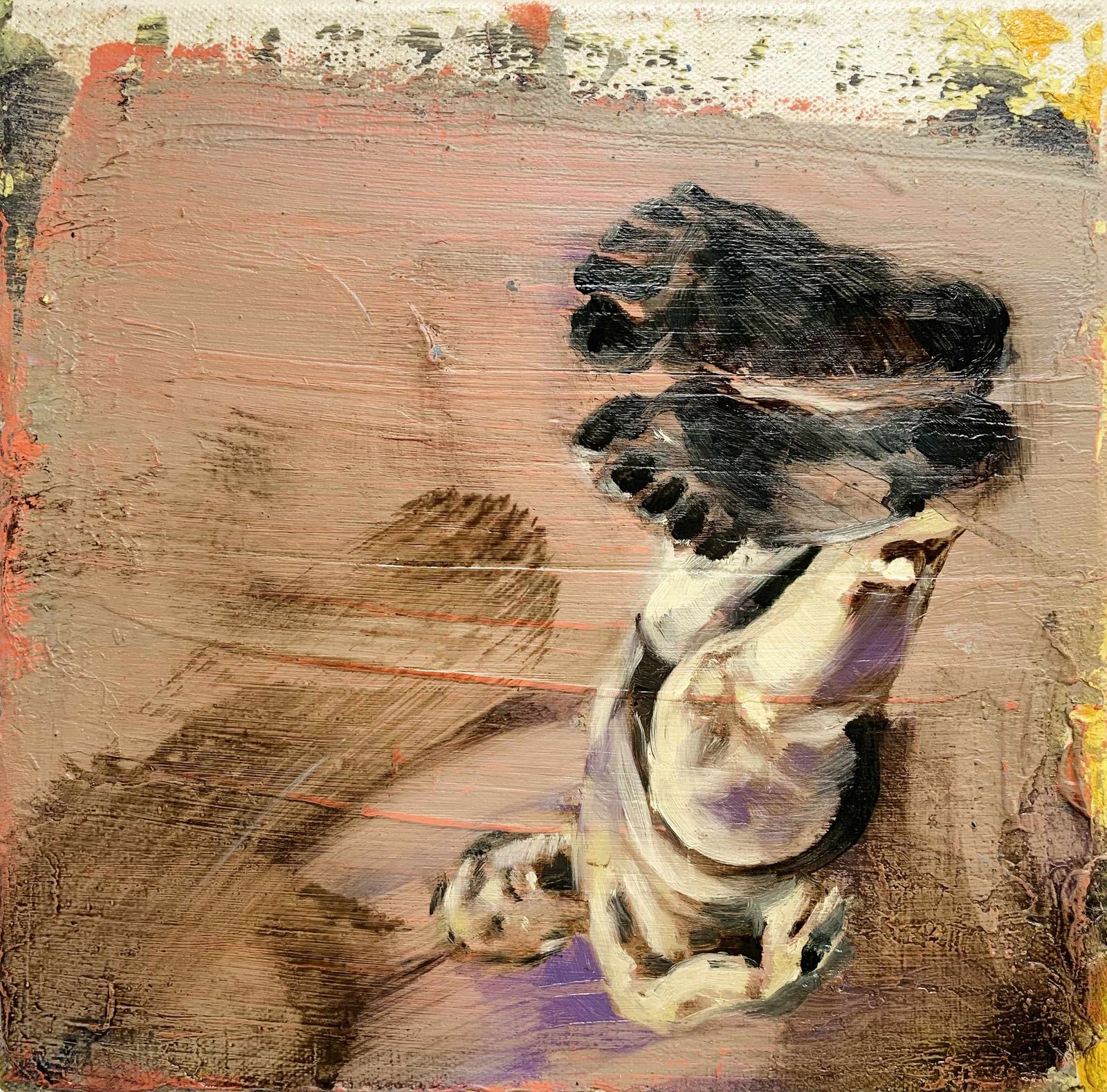
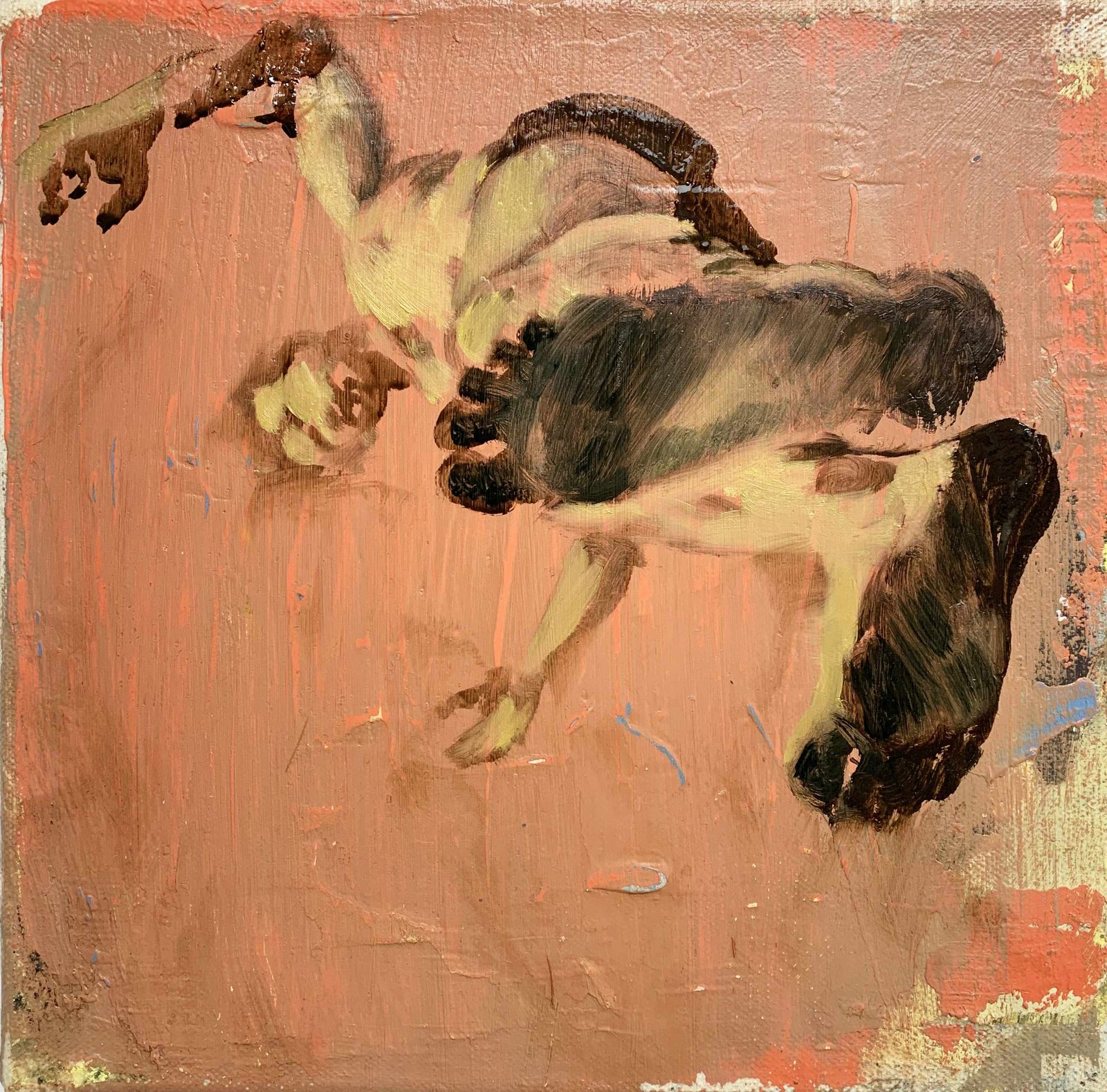
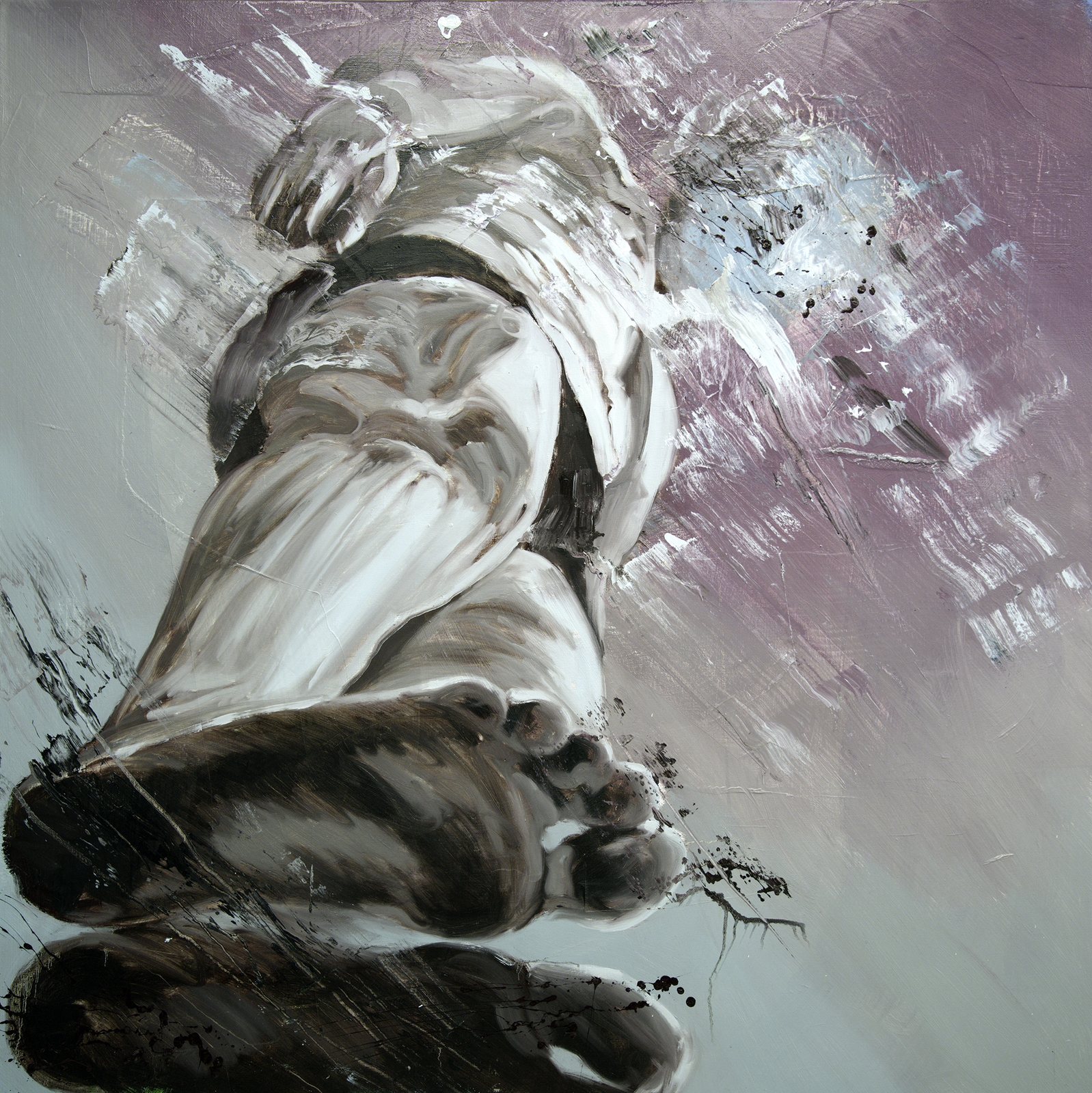
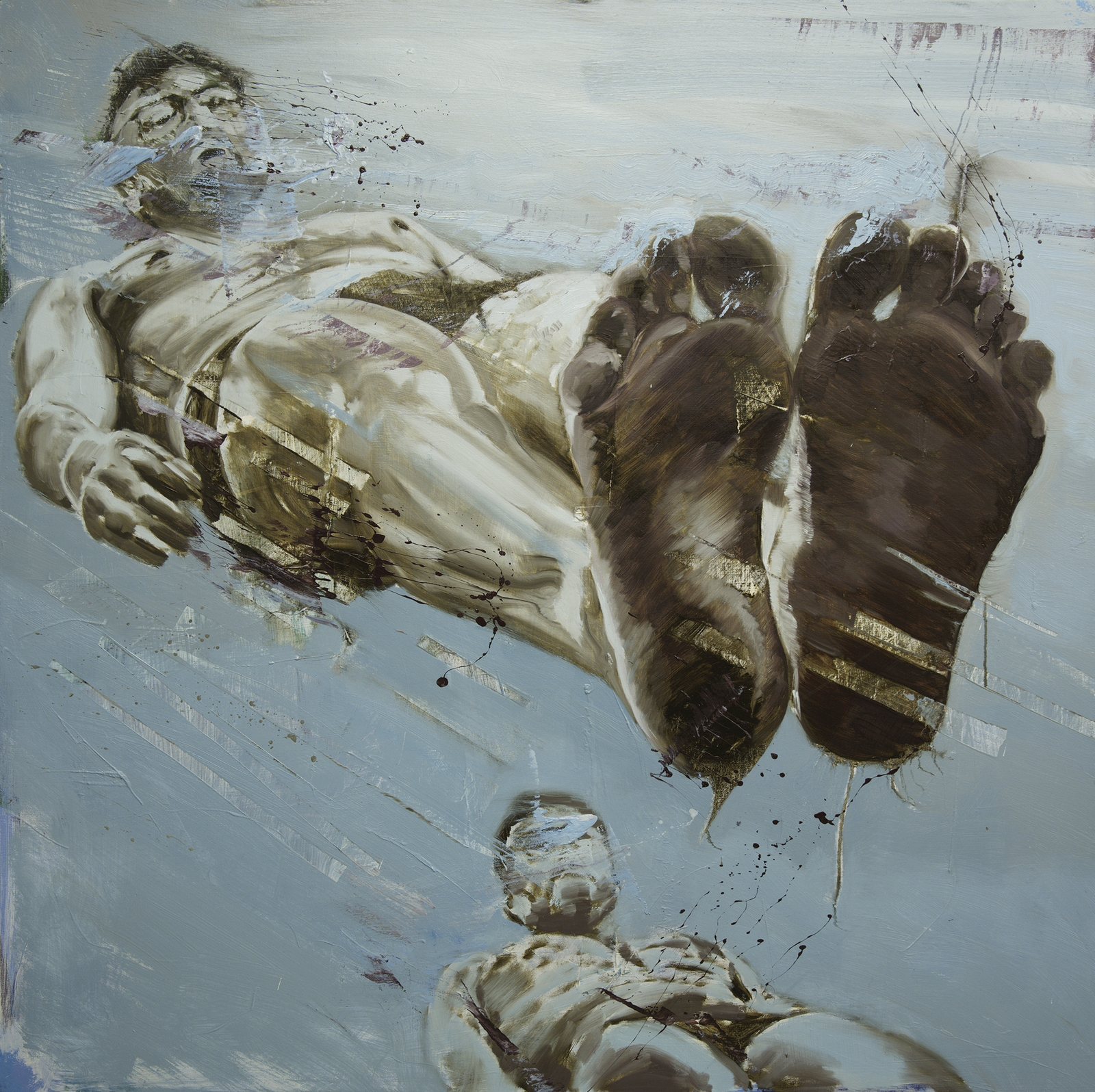
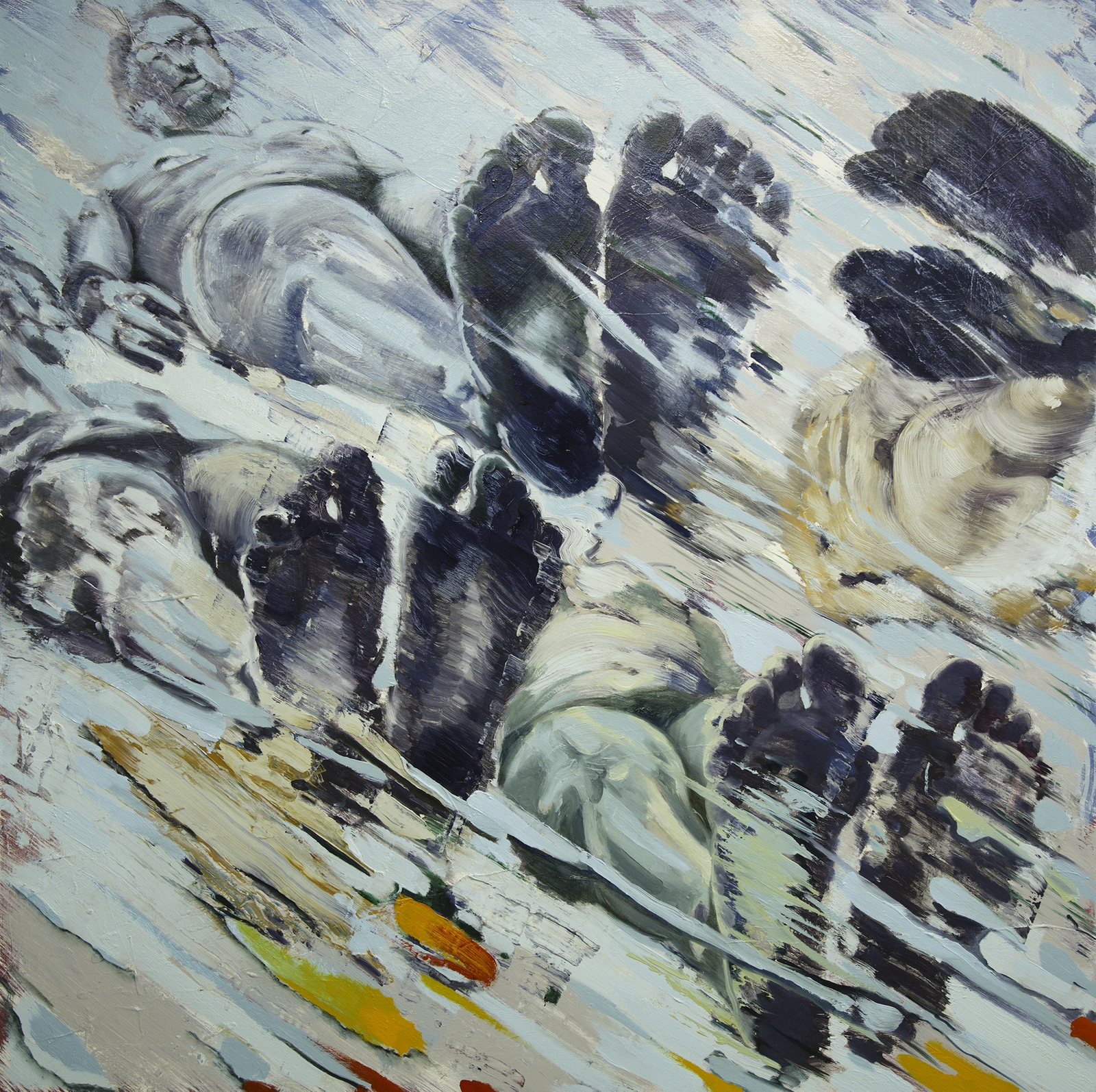
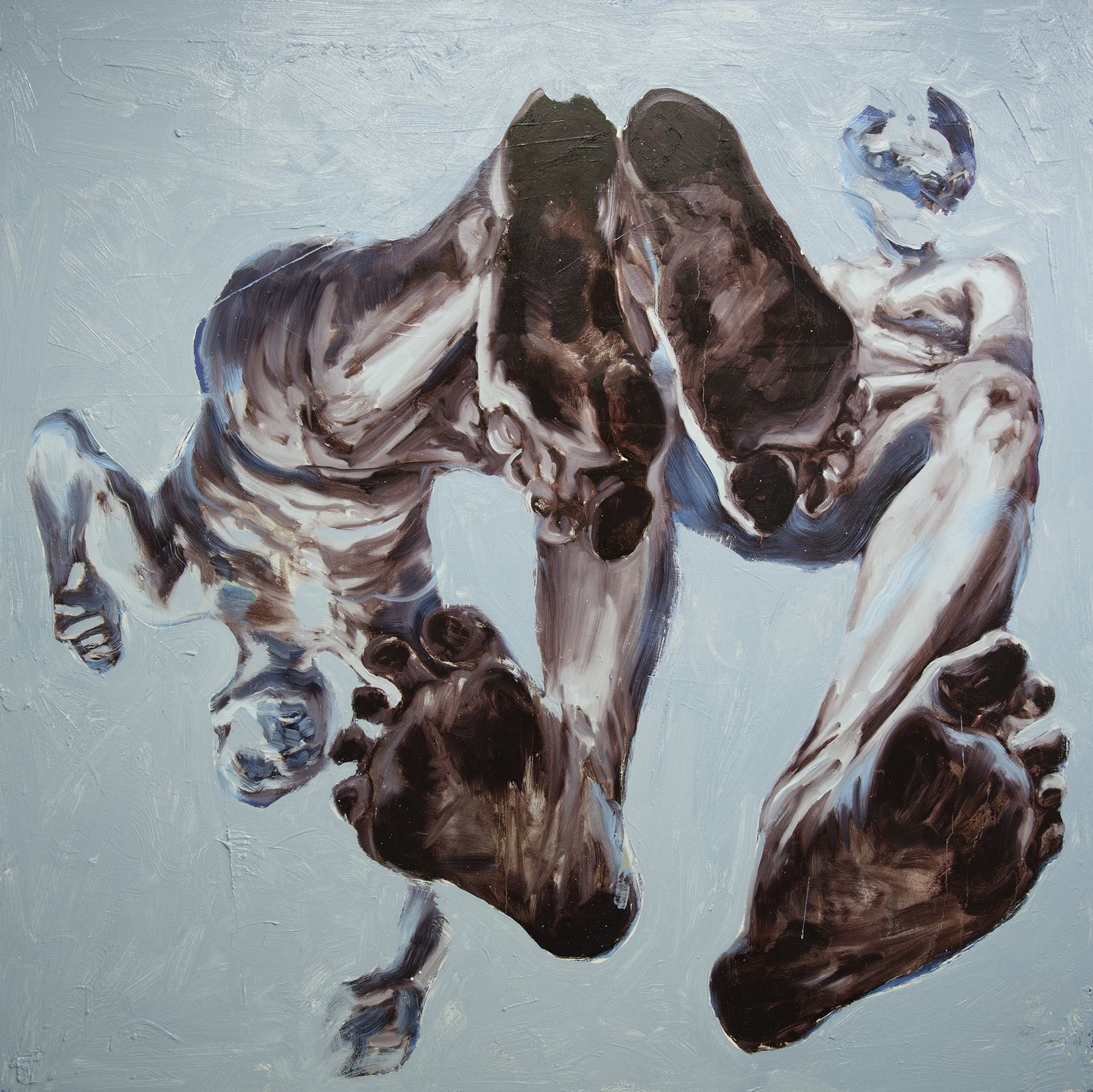
My newest series is called Apogee, and it began in July 2026. I am an abstract figurative artist, and Apogee is abstract figurative art at its most direct. Each painting shows a single human figure seen from the feet. The body is foreshortened. It rises away from the viewer, soles first, the head far off and small. I took the viewpoint from the frescoes of Italy, where painted figures stand high on walls and ceilings and are read from below.
The making matches the view. Some of these figures were painted directly on my studio wall, the way a fresco is painted on plaster. The brushwork is aggressive and left unblended. The series is built as ten works, called Fragments. The early Fragments are small, in ink, acrylic, and oil on canvas. Two small Fragments went to a group exhibition in Belgrade, Serbia, in the fall of 2026. The newest are large canvases, 48 by 48 inches, where one rising figure fills the whole square.
I bring Apogee to this page for a reason that fits the city. Jersey Village held its shape. Everything around it changed, and the city kept the drawing its founders made: the lake at the center, the streets laid out in 1954, the border fixed in 1956. A painting also holds or loses its shape. In Apogee the figure is under the strongest pressure I can put on it: seen from the wrong end, stretched across the canvas, the ground pulled away beneath it. It holds anyway. That is what the series is about. A form that keeps itself under pressure.
For readers looking for original paintings in Jersey Village, the route is simple. There is no gallery between this city and the work. The Apogee series page shows all ten Fragments in full. The online store carries the current original paintings, which ship from Texas. Jersey Village TX art, as this site records it, is the work of a painter in the same state, offered directly to a small city that has always known exactly what it is.
Visiting, and where the record continues
A Jersey Village visit is short and plain. Drive in from U.S. Highway 290. See the lake first, then the streets that gathered around it. The map on this page centers on the Civic Center on Lakeview Drive, a short distance from the lake shore. Play the golf course if you play. The fairways run over the dairy ground, and that is the city’s whole story in one walk: pasture to city, nothing wasted, nothing renamed away.
The record continues across this site. The Apogee series page holds the paintings in full. The Houston page holds my museum district record in this metroplex. The Texas page gathers my state story in one arc, and the Dallas page carries my exhibition record in the city where my studio life is rooted. The formal lines are on my CV page, and all the town pages of this site meet on the Market page. Jersey Village has no wall of mine yet. It has the lake, the fairways, and its own name on its own city hall. The paintings are ready when the city is.
Frequently Asked Questions
Has Bartosz Beda exhibited in Jersey Village, Texas?
I have no exhibition in Jersey Village to report. No gallery here has shown my work. Jersey Village has no gallery to show it in. It is a residential city, and this page treats it as one. My Houston record sits southeast of here, in the museum district. I go to Houston to look: at the Museum of Fine Arts, at the Menil Collection, at the museum district rooms that set the standard for this whole region.
How did Jersey Village get its name?
Before it was a city, this ground was a dairy. Clark W. Henry owned 1,236 acres here. On that land he operated F&M Dairy and raised Jersey cattle. Jersey cattle are a small, hardy dairy breed, first bred on the island of Jersey in the English Channel. They give rich milk, and they suit a hot climate better than most dairy breeds. The Handbook of Texas repeats the naming story with care: Henry ran the dairy, and the new development was named for his Jersey cows. Jersey Village is, in the plainest sense, the village of the Jersey herd.
Who founded Jersey Village, Texas?
As Clark W. Henry’s health declined, he gave up the dairy, and the land was opened for a residential community. The change came in 1953 and 1954. Henry and LeRoy Kennedy, both members of the Garden Oaks Baptist Church, began developing the community in February 1954. The plan was drawn whole from the start. Space was set aside for homes, for a school, for a park, and for an eighteen hole golf course. At the center of the plan sat a small lake, Jersey Lake.
Why did Jersey Village incorporate in 1956?
On April 16, 1956, Jersey Village incorporated. All 58 votes cast were in favor. The new city began with a volunteer police force. Incorporation mattered for one practical reason. Because Jersey Village was now a city of its own, Houston could not annex its territory. The village pattern was locked in while the land around it was still open. Houston grew to every edge of it, and stopped.
What is Jersey Lake?
A small lake sat at the center of the founders’ plan. The lake still anchors the city. It is owned and maintained by a homeowners association, and residents whose homes stand on its shores, and their guests, can fish in it. A city that began as pasture kept water at its center, and the houses gathered around it.
What is Jersey Meadow Golf Course?
The golf course in the founders’ plan also stayed. Jersey Meadow Golf Course, the city’s municipal course, runs over the old farm ground. The site that once held a large herd of Jersey dairy cattle now holds fairways. The ground changed its crop. It stayed green.
How many people live in Jersey Village, Texas?
Growth was slow at first. In 1961 the city counted 493 residents. The population rose through the following decades: 4,084 in 1982, and 7,921 at the 2020 census. The city covers about three and a half square miles. It has its own mayor, its own council, its own police department, and its own fire department. Houston surrounds it on every side, and Houston never absorbed it.
What government does Jersey Village have?
In August 1986 the voters passed a home rule charter, 306 votes to 36. A home rule charter gave the city wider governing and taxing powers than it had held as a general law city. Jersey Village today runs under that charter, with a council and manager form of government. The mayor and five council members serve two year terms. The city manager runs the daily work. The council meets at the Civic Center on Lakeview Drive.
When did the first family move into Jersey Village?
Building began in February 1954. The first ground held about five miles of streets, with drainage, gas, sewage, and water service laid in. The first houses rose along Jersey Drive. The first family moved into the subdivision in late October 1954. The community was barely a year old when it made the decision that fixed its future, the incorporation vote of 1956.
Why does the Jersey Village page present the Apogee paintings?
Apogee is my newest series of figure paintings, and it began in July 2026. Each painting shows a single human figure seen from the feet. The body is foreshortened. It rises away from the viewer, soles first, the head far off and small. I took the viewpoint from the frescoes of Italy. Some of these figures were painted directly on my studio wall, the way a fresco is painted on plaster. The series is built as ten works, called Fragments. Two small Fragments went to a group exhibition in Belgrade, Serbia, in the fall of 2026. The newest are large canvases, 48 by 48 inches. Jersey Village held its shape while everything around it changed. In Apogee the figure is under the strongest pressure I can put on it, and it holds anyway. That is what the series is about. A form that keeps itself under pressure.