
Old East Dallas, TX: Portrait Paintings and the Saved Houses of Swiss Avenue
Old East Dallas is the historic quarter east of downtown Dallas. It is a place of wide porches and houses that were almost lost. Swiss Avenue runs through it as its grand street. Munger Place spreads beside it in Prairie houses. Junius Heights adds block after block of Craftsman bungalows built for streetcar riders. This page is a guide to that quarter, written by a painter who works in Dallas today.
These neighborhoods survived because people chose to save houses. A painter understands that choice. Saving a house and saving a face on paper are both acts of attention. You decide what must not disappear.
Old East Dallas in my record
I have no exhibition inside Old East Dallas itself, and this page says so plainly. No gallery on Swiss Avenue has shown my work. No house museum here has hung my paintings. I will not invent a connection that does not exist.
My real record stands a short drive east. In 2023 my work hung at the Bath House Cultural Center on White Rock Lake, in the group exhibition Self Unfixed. The Bath House is the cultural center for East Dallas. It sits on the lake shore, past Lakewood, and it has served this side of the city for decades. The Lakewood page on this site holds that record in full.
From Old East Dallas, the Bath House is the natural next stop. It began as a bath house in 1930 and now holds exhibitions, theater, and classes. That is the honest shape of my link to this quarter.
Swiss Avenue and the historic district
Swiss Avenue is the grand street of Old East Dallas. It began as a country lane. Swiss immigrant Henri Boll named it for his homeland in 1857. Then it became the centerpiece of a planned suburb.
Cotton gin manufacturer Robert S. Munger developed Munger Place in 1905. Swiss Avenue was lengthened and paved as part of that plan. The Texas historical marker on the avenue calls Munger Place an exclusive residential area of 140 acres. Dr. R. W. Baird built the first house on the avenue in 1905, at 5303 Swiss Avenue. It was a Classical Revival house, and it set the tone. Large lots followed. Brick and stone houses rose on both sides.
The houses hold almost every revival style of their time. You can read Prairie, Georgian, Mediterranean, Tudor, Neoclassical, and Colonial Revival forms along a few blocks. The City of Dallas counts about 200 homes in the district, in intact and restored condition. The avenue was the first paved street in Dallas, a fact the district still repeats with pride.
By the middle of the twentieth century, that promise looked broken. Large houses were divided into apartments. Some were demolished. The neighborhood declined. Then residents and the Historic Preservation League fought to save it. In 1973 the city designated Swiss Avenue as its first historic district. In 1974 the whole district entered the National Register of Historic Places.
That 1973 decision changed Dallas. It proved that an old street could be protected by law, not only by luck. Every historic district that followed walks through a door that Swiss Avenue opened. The annual Mother’s Day home tour now draws visitors each May to porches that were once at risk of demolition.
One smaller group tells the same story at an earlier date. The Wilson Block stands at 2902 to 2922 Swiss Avenue, at the downtown end of the street. Frederick P. Wilson and his wife Henrietta built their Queen Anne house at 2922 Swiss Avenue in 1899. They built rental houses beside it, and the block stayed in family hands for close to eighty years. The block entered the National Register in 1978. The Meadows Foundation restored the houses in the 1980s, and the Wilson House became a center for preservation work in Dallas.
Munger Place and the streetcar neighborhoods
Swiss Avenue was one part of a larger plan. Munger Place as a whole covered about 300 acres. Robert S. Munger and his brother Collett laid it out in 1905 as one of the first suburbs of Dallas. It was the first deed restricted neighborhood in Texas. Houses had to stand a full two stories. Each house had to cost at least 2,000 dollars to build. No house could face a side street. Paved streets and electric lights completed the offer. The leading families of Dallas bought lots, and the area filled in a few short years.
Today the Munger Place Historic District holds more than 250 households. It is known for the largest collection of Prairie style homes in the country. The district entered the National Register in 1978, and Dallas recognized it as a landmark district in 1980. Stand on Worth Street or Junius Street and the plan still reads clearly. The houses face forward. The porches line up. The suburb was designed as a composition, and it still holds together as one.
East of Munger Place, the streetcar built a different kind of neighborhood. Junius Heights began in 1906, at what was then the eastern edge of Dallas. Preservation Dallas records that the Junius Heights streetcar began running on September 2, 1906. Buyers rode out that day to view the plots. Because it was a Sunday, no lots could be sold. Buyers waited until midnight. A pistol shot marked the start of the sale. Within an hour, about 200 lots had sold. Within days, the neighborhood was sold out.
Junius Heights grew into a streetcar suburb of Craftsman bungalows, Prairie houses, and Tudor cottages. Its building years ran from 1906 into the 1930s. In 2006 Dallas created the Junius Heights Landmark District. It covers more than 700 structures on about 190 acres. It is the largest historic district in Dallas. The contrast is the point. Swiss Avenue was built for wealth and display. Junius Heights was built for families riding the car to work. Old East Dallas holds both, and both were saved.
A short history of Old East Dallas
Old East Dallas began as a separate place. Families settled east of Dallas in the 1860s. William H. Gaston began promoting the area in 1872, the year the railroads arrived. The Houston and Texas Central reached East Dallas on July 16, 1872. The Texas and Pacific followed on February 22, 1873. Gaston gave the railroads money and free right of way through his land to bring them here.
On September 9, 1882, East Dallas incorporated as its own town on 1,400 acres. By the late 1880s it held about 6,000 people. The Texas State Historical Association records that East Dallas was considered the most luxurious place to live in Dallas County. By 1889, ninety percent of its houses had running water. In 1886 it built the first all brick schoolhouse in Dallas County. The Texas State Fair opened at nearby Fair Park in 1886, and streetcars carried crowds through the town to the fair and the horse racing track.
The separate town did not last. In 1889 the Texas legislature revoked the East Dallas charter so the town could join Dallas. On January 1, 1890, East Dallas became part of Dallas. The merger made Dallas the largest city in Texas in the 1890 census. Dallas took over the streets, schools, public buildings, and debts of its neighbor. The word old in Old East Dallas is not decoration. It marks a town that existed before it became a neighborhood.
The boom that followed annexation made the quarter. Peak’s Suburban Addition, platted from 1879, is among the oldest residential areas in the city. Munger Place and Junius Heights followed in 1905 and 1906. After the Second World War, growth moved outward. The grand houses aged, and demolition took its share.
Preservation reversed the slide. The Swiss Avenue designation in 1973 came first. The Wilson Block restoration followed. Munger Place gained landmark status in 1980. Junius Heights completed the pattern in 2006. Families bought back the old houses, one porch at a time. That long rescue, led by residents, is why Old East Dallas reads today as the saved quarter of Dallas.
Owing to the Absence: portraits for period houses
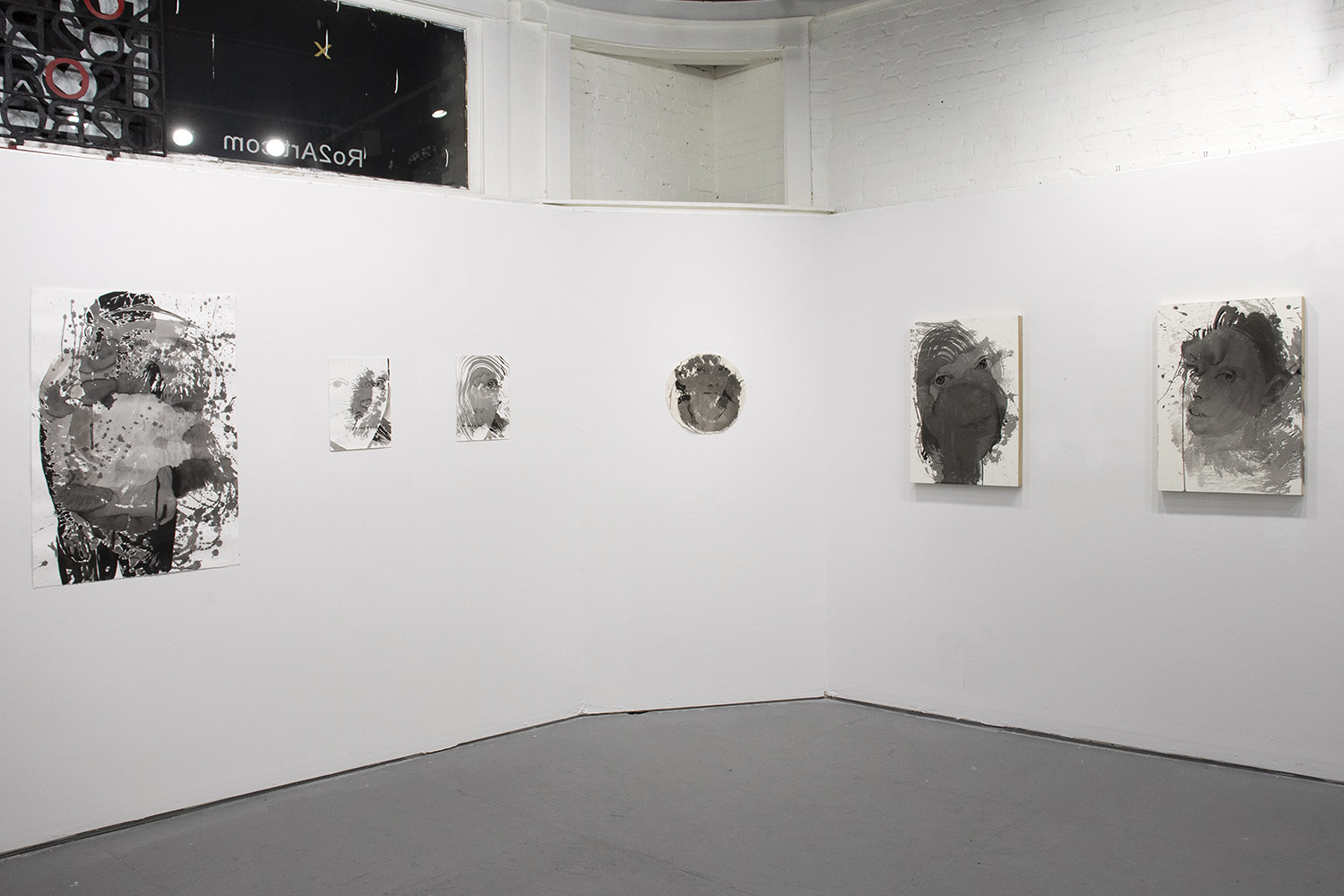
My series Owing to the Absence is a body of ink paintings on paper. I made the work during a Dallas residency from 2022 to 2023, and I have continued to show it since. Each sheet holds a head or a figure drawn in black ink. Some faces are clear. Some dissolve into wash and shadow. The series asks what remains of a person when part of the image is missing. That question fits this quarter. Every saved house here is also a partial record. The porch remains. The first family is gone. The rooms hold new lives inside old walls.
I work as an abstract figurative artist. The figure stays at the center of the painting, but it is never a simple likeness. Form breaks, returns, and breaks again. In the Owing works, portraiture becomes a study of presence and absence. A jaw line carries the person. An empty passage carries the loss. The paper stays visible, and the white of the sheet does as much work as the ink.
These are portrait paintings made for close rooms. A large oil painting needs a large wall and a long view. An ink portrait asks for the opposite. It rewards the distance of a hallway, a study, or a landing on a staircase. Period houses are full of such places. Old East Dallas art, at its best, has always lived at that scale. Small framed works hung in parlors. Portraits kept on stair walls. Drawings passed down inside families. My ink works enter that tradition in a contemporary language, without costume and without imitation.
Readers looking for original paintings in Old East Dallas often start with a room, not with a style. A restored Prairie house in Munger Place has warm wood, low light, and walls that suit black ink on white paper. A Tudor cottage in Junius Heights has smaller rooms where a single framed portrait can hold a whole wall. The Owing sheets were made sheet by sheet, by hand, and each one is a single original. There is no second copy of a wash. Once the ink dries, the decision stands, much like a restoration decision on an old house.
The full series stands on its own page on this site, linked below. The online store carries the current originals. Start with the room you use most. The right portrait is the one you keep noticing from the doorway.




Visiting, and where to go next
Walk Swiss Avenue first, from Fitzhugh Avenue toward La Vista Drive. Read the historical marker at 5501 Swiss Avenue. Look at the Wilson Block at the downtown end of the street. Then cross into Munger Place and walk Worth and Junius streets for the Prairie houses. Finish in Junius Heights, where the bungalows show the streetcar city at its most complete. The map on this page centers on the Swiss Avenue Historic District.
Official information helps the walk. The City of Dallas pages carry the Swiss Avenue ordinance and reports. The Swiss Avenue Historic District association publishes district news and tour details. Preservation Dallas holds tours and research on the wider quarter.
My own pages continue from here. The Owing to the Absence series page holds the portraits in full. The store carries the original paintings. The Lakewood page tells the Bath House story, where my East Dallas exhibition record stands. The Texas page gathers my work across the state, and the Dallas page covers my record in the city as a whole. My CV page holds the formal exhibition record, and the Market page links every town page on this site. Old East Dallas has no painting of mine on its walls yet. It has proof, in brick and timber, that careful looking can save what a city loves.
Frequently Asked Questions
Has Bartosz Beda exhibited in Old East Dallas?
I have no exhibition inside Old East Dallas itself. No gallery on Swiss Avenue has shown my work, and no house museum here has hung my paintings. My real record stands a short drive east. In 2023 my work hung at the Bath House Cultural Center on White Rock Lake, in the group exhibition Self Unfixed. The Bath House began as a bath house in 1930 and now holds exhibitions, theater, and classes, and it serves as the cultural center for East Dallas.
Who named Swiss Avenue in Dallas?
Swiss Avenue began as a country lane. The Swiss immigrant Henri Boll named it for his homeland in 1857. It later became the centerpiece of a planned suburb: cotton gin manufacturer Robert S. Munger developed Munger Place in 1905, and Swiss Avenue was lengthened and paved as part of that plan. Dr. R. W. Baird built the first house on the avenue in 1905, at 5303 Swiss Avenue, a Classical Revival house that set the tone.
Who developed Munger Place in Dallas?
Robert S. Munger and his brother Collett laid out Munger Place in 1905 as one of the first suburbs of Dallas, about 300 acres in all. It was the first deed restricted neighborhood in Texas. Houses had to stand a full two stories. Each house had to cost at least 2,000 dollars to build. No house could face a side street. Today the Munger Place Historic District holds more than 250 households and is known for the largest collection of Prairie style homes in the country.
When did Swiss Avenue become a historic district?
By the middle of the twentieth century the large houses had been divided into apartments and some were demolished. Residents and the Historic Preservation League fought to save the street. In 1973 the city designated Swiss Avenue as its first historic district, and in 1974 the whole district entered the National Register of Historic Places. The City of Dallas counts about 200 homes in the district. The avenue was the first paved street in Dallas, and the annual Mother’s Day home tour now draws visitors each May.
What is the Wilson Block on Swiss Avenue?
The Wilson Block stands at 2902 to 2922 Swiss Avenue, at the downtown end of the street. Frederick P. Wilson and his wife Henrietta built their Queen Anne house at 2922 Swiss Avenue in 1899. They built rental houses beside it, and the block stayed in family hands for close to eighty years. The block entered the National Register in 1978. The Meadows Foundation restored the houses in the 1980s, and the Wilson House became a center for preservation work in Dallas.
How did Junius Heights sell out in days in 1906?
Junius Heights began in 1906, at what was then the eastern edge of Dallas. Preservation Dallas records that the Junius Heights streetcar began running on September 2, 1906. Buyers rode out that day to view the plots. Because it was a Sunday, no lots could be sold. Buyers waited until midnight. A pistol shot marked the start of the sale. Within an hour, about 200 lots had sold, and within days the neighborhood was sold out.
How large is the Junius Heights Landmark District?
In 2006 Dallas created the Junius Heights Landmark District. It covers more than 700 structures on about 190 acres, and it is the largest historic district in Dallas. Junius Heights grew into a streetcar suburb of Craftsman bungalows, Prairie houses, and Tudor cottages, with building years running from 1906 into the 1930s. Swiss Avenue was built for wealth and display. Junius Heights was built for families riding the car to work. Old East Dallas holds both.
When was East Dallas its own town?
On September 9, 1882, East Dallas incorporated as its own town on 1,400 acres. By the late 1880s it held about 6,000 people, and it was considered the most luxurious place to live in Dallas County. By 1889, ninety percent of its houses had running water, and in 1886 it built the first all brick schoolhouse in Dallas County. In 1889 the Texas legislature revoked the East Dallas charter, and on January 1, 1890, East Dallas became part of Dallas. The merger made Dallas the largest city in Texas in the 1890 census.
Who brought the railroads to East Dallas?
William H. Gaston began promoting the area in 1872, the year the railroads arrived, and he gave the railroads money and free right of way through his land to bring them here. The Houston and Texas Central reached East Dallas on July 16, 1872. The Texas and Pacific followed on February 22, 1873. The Texas State Fair opened at nearby Fair Park in 1886, and streetcars carried crowds through the town to the fair and the horse racing track.
Why do ink portraits suit Old East Dallas period houses?
A large oil painting needs a large wall and a long view. An ink portrait asks for the opposite: it rewards the distance of a hallway, a study, or a landing on a staircase, and period houses are full of such places. A restored Prairie house in Munger Place has warm wood and low light that suit black ink on white paper. Each Owing sheet was made by hand and is a single original. There is no second copy of a wash. Once the ink dries, the decision stands, much like a restoration decision on an old house.