
Spokane, Washington: My First Solo Exhibition in the United States
Spokane, in eastern Washington, is where my American exhibition record begins. In July 2016, Marmot Art Space, a small gallery in the Kendall Yards district, presented Hear My Voice, my first solo exhibition in the United States. I was based in Moscow, Idaho, at the time, about an hour and a half drive away, and the paintings were made there and carried north. I had shown widely in Britain and Europe, and London had been generous to me: I was shortlisted for Saatchi New Sensations in 2012 and named in the Catlin Art Guide of that year. None of that counted in Spokane. An American solo show is a different test: a new country, a new audience, and no reputation carried over. Spokane was the door. This page is the record of that exhibition, and a guide to the art of the city around it.
The exhibition
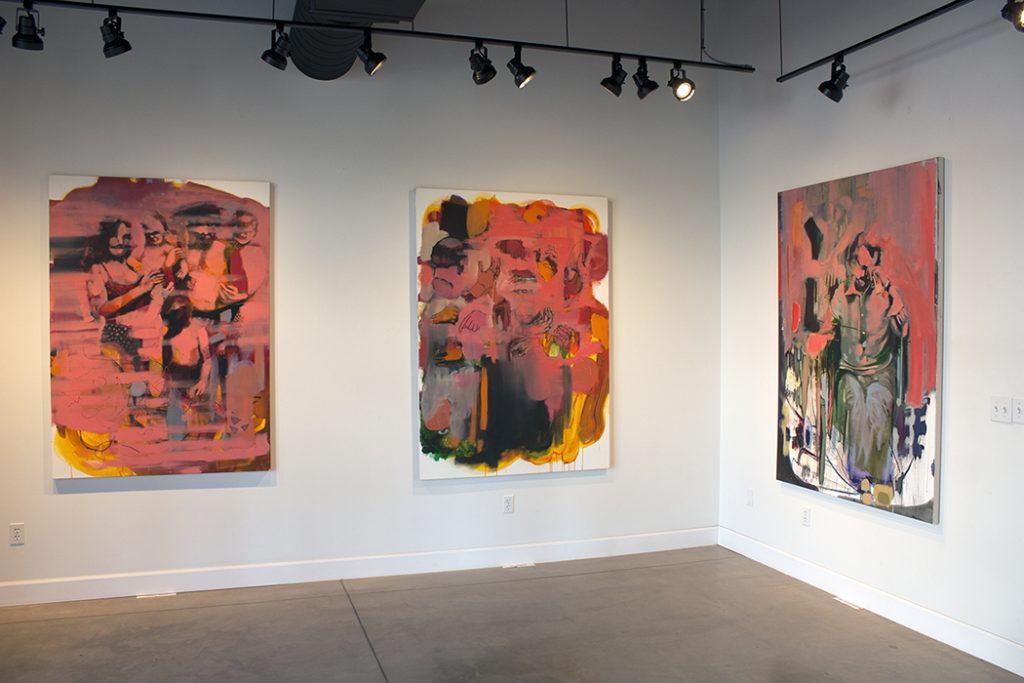
Hear My Voice opened on the First Friday of July 2016. The opening reception ran on Friday, July 1, from 5 to 8 in the evening, and the exhibition stayed up through the month. First Friday is the night the Spokane galleries open together, and Kendall Yards, a young district built on the old rail yards on the north bank of the Spokane River, was still new. The gallery was one room on West Summit Parkway, and the work filled it: new paintings in oil, laid on thick with brush and knife, in the impasto method I was working in then. The Inlander described the pictures as reflections on social anxieties and the lessons of history. That was exact. It was also my most Polish exhibition to date, painted in Idaho by a man who had arrived from England three years before.

The paintings
The paintings of that year are gathered on this site on the Paintings 2016 page, linked below, and two installation photographs on that page were taken inside Marmot during the show. The largest picture reworked an old photograph of Lech Walesa, the Polish freedom leader, on a family holiday at the beach: a cheerful scene that turns uneasy the longer you look at it, the eyes blotted out, the brushwork unfinished and fast. Walesa appeared in other canvases of that year as well, and so did Pope John Paul II, in Pope I and Pope II, small oils on paper. Around them hung the Neither Sisters, Neither Twins and Neither Brothers, Neither Twins groups, the Man of Hope, and the Europa and Vacation canvases. The year was one long argument with the history I grew up inside, made in the months when Britain voted to leave Europe and America moved toward its own election.
The title stayed with me after the show closed. Hear My Voice became the title of my book, published in London the following year, and the demand underneath it, to be heard in a place where nobody knows your name, is still the demand the work makes in every new city. Spokane heard it first.


The studio in Moscow, Idaho
My American years began in a rented studio in Moscow, Idaho. I first came in 2013, meaning to visit for a month. My wife had taken a post teaching art at the University of Idaho, and I had a solo exhibition waiting in Madrid that needed paintings. So I rented a studio in Moscow, finished the work there, and sent it to Spain. Three years later I was still in that studio: a plain room in the back yard of a house near downtown Moscow, a tall table of oil tubes and drying brushes, up at 4 in the morning and painting some days until 10 at night. The Spokesman-Review described the room exactly, and its article is republished on this site.
Moscow is a university town on the Palouse, the rolling wheat country of the Idaho Panhandle. From there, Spokane was the city: the drive north runs about an hour and a half. In 2016 I also taught as an adjunct at the University of Idaho and gave an artist talk there, titled Beyond Painting. Most of the 2016 paintings were produced in that Moscow studio, as I wrote on the Paintings 2016 page at the time. The Spokane show was painted in Idaho and hung in Washington, which is how the Inland Northwest works.
The press
Both of the city papers of record covered the exhibition, and both articles are republished in full on this site, linked below, with links to the originals. The Inlander, the Spokane alternative weekly, announced the show under the headline of a Polish artist whose first solo show in the United States had landed in Spokane. It reported something the gallery curator, Marshall Peterson, said he had never experienced with another visiting artist: collectors were already purchasing the work during the run.
The Spokesman-Review sent its visual arts correspondent and ran a full profile under the headline: From Poland and England, Bartosz Beda is an artist on the rise. Peterson told the paper to imagine that a young Picasso, Warhol or Dali just happened to be passing through Spokane. The profile also caught the Moscow studio, the Walesa paintings, and my own account of the title: those three words, hear my voice, were the momentum of the whole adventure. The clippings of both articles sit on the press posts of this site, and they are reused on this page, because press like that is part of the exhibition record, not decoration.


Marmot Art Space, then and now
Marmot Art Space was the creation of Marshall Peterson, the curator quoted in the 2016 articles, built with the Kendall Yards developers. His eye made the gallery’s reputation: it won the Inlander Best Of competition and showed the strongest regional artists alongside visitors like me. Peterson died in June 2026. The gallery continues in the same district, at 1202 West Summit Parkway, carried forward by the owners of Front Room Art Gallery, who write on the gallery site that they are honored to carry his legacy forward. It still opens on First Fridays, from 5 to 8 in the evening. A map of Kendall Yards sits on this page.
A short history of Spokane
Spokane is older than its skyline. The Spokane Tribe, whose name is read as Children of the Sun, gathered for centuries at the falls of the Spokane River, where the salmon ran. The river still drops through the middle of downtown in falls that are among the largest urban waterfalls in the country. In 1810 the North West Company built Spokane House, a fur trading post at the meeting of the Spokane and Little Spokane rivers, the first lasting European settlement in the region. Settlers followed the water power: a sawmill stood at the falls by 1871, and in 1873 James N. Glover bought the claims and laid out the town. He is remembered as the father of Spokane.
The city was incorporated in 1881 as Spokane Falls, and the railroads made it the trading hub of the Inland Northwest. In 1887 the Jesuit priest Joseph Cataldo founded Gonzaga University beside the river. On August 4, 1889, the Great Fire destroyed the wooden downtown. Spokane rebuilt at once in brick and stone, and much of its historic core dates from that rebuilding. The name was shortened to Spokane in 1891. Lilacs planted from the early years of the new century gave the city its nickname, the Lilac City, and its Lilac Festival has run each May since 1938.
In 1974 the city did something unlikely. It hosted a world fair, Expo 74, the first world fair given an environmental theme, and Spokane was the smallest city ever to hold one. The fairgrounds were the rail yards along the river. When the fair closed, the ground became Riverfront Park, 100 acres around the falls in the center of the city, with the fair United States Pavilion and the old Great Northern clock tower still standing in it. A painter who showed in Kendall Yards, on the next stretch of the same riverbank, was working downstream of that whole history.
Art in Spokane
The museum anchor of the region is the Northwest Museum of Arts and Culture, known as the MAC, in the Browne Addition neighborhood west of downtown, at 2316 West First Avenue. It grew out of the Spokane Historical Society of 1916, it is a Smithsonian Affiliate, and it keeps the art, history, and tribal culture of the Inland Northwest. Its Plateau tribal collection is described as the largest of its kind in the world, and its stores hold more than a million objects across art, artifacts, documents, and photographs. The campus includes the Campbell House of 1898, a Tudor Revival mansion designed by Kirtland Cutter and kept as a house museum. The museum is open Tuesday to Sunday, from 10 in the morning to 5 in the evening, and until 8 on the last Wednesday of the month.
Kendall Yards today is the gallery district I remember, grown up: Marmot still opens on First Fridays, the city First Friday program runs galleries across the center on the same evening, and Gonzaga University keeps its own exhibition space in the Jundt Art Museum on its campus. For a first American show, Spokane gave me a working gallery, two serious newspapers, and collectors who bought. Painters start in bigger cities and get less.
The Spokane record on this site is the two press posts linked below, the Paintings 2016 page, and the formal lines on my CV and Press pages. The paintings available now are in the online store. City services and visitor information sit with the City of Spokane, linked below.
Frequently Asked Questions
What was Bartosz Beda’s first solo exhibition in the United States?
Spokane, in eastern Washington, is where my American exhibition record begins. In July 2016, Marmot Art Space, a small gallery in the Kendall Yards district, presented Hear My Voice, my first solo exhibition in the United States. It opened on the First Friday of July 2016. The opening reception ran on Friday, July 1, from 5 to 8 in the evening, and the exhibition stayed up through the month. I was based in Moscow, Idaho, at the time, about an hour and a half drive away, and the paintings were made there and carried north.
What paintings were in the Spokane exhibition?
The gallery was one room on West Summit Parkway, and the work filled it: new paintings in oil, laid on thick with brush and knife, in the impasto method I was working in then. The largest picture reworked an old photograph of Lech Walesa, the Polish freedom leader, on a family holiday at the beach: a cheerful scene that turns uneasy the longer you look at it. Walesa appeared in other canvases of that year as well, and so did Pope John Paul II, in Pope I and Pope II, small oils on paper. Around them hung the Neither Sisters, Neither Twins and Neither Brothers groups, the Man of Hope, and the Europa and Vacation canvases. The paintings of that year are gathered on the Paintings 2016 page on this site, and two installation photographs on that page were taken inside Marmot during the show.
Where was Bartosz Beda’s studio in 2016?
My American years began in a rented studio in Moscow, Idaho. I first came in 2013, meaning to visit for a month. My wife had taken a post teaching art at the University of Idaho, and I had a solo exhibition waiting in Madrid that needed paintings. So I rented a studio in Moscow, finished the work there, and sent it to Spain. Three years later I was still in that studio: a plain room in the back yard of a house near downtown Moscow, up at 4 in the morning and painting some days until 10 at night. In 2016 I also taught as an adjunct at the University of Idaho and gave an artist talk there, titled Beyond Painting.
What did the Spokane press say about the exhibition?
Both of the city papers of record covered the exhibition, and both articles are republished in full on this site. The Inlander, the Spokane alternative weekly, announced the show and reported something the gallery curator, Marshall Peterson, said he had never experienced with another visiting artist: collectors were already purchasing the work during the run. The Spokesman-Review sent its visual arts correspondent and ran a full profile under the headline: From Poland and England, Bartosz Beda is an artist on the rise. Peterson told the paper to imagine that a young Picasso, Warhol or Dali just happened to be passing through Spokane.
Who was Marshall Peterson of Marmot Art Space?
Marmot Art Space was the creation of Marshall Peterson, the curator quoted in the 2016 articles, built with the Kendall Yards developers. His eye made the gallery’s reputation: it won the Inlander Best Of competition and showed the strongest regional artists alongside visitors like me. Peterson died in June 2026. The gallery continues in the same district, at 1202 West Summit Parkway, carried forward by the owners of Front Room Art Gallery, who write on the gallery site that they are honored to carry his legacy forward. It still opens on First Fridays, from 5 to 8 in the evening.
What does the title Hear My Voice mean to him?
The title stayed with me after the show closed. Hear My Voice became the title of my book, published in London the following year, and the demand underneath it, to be heard in a place where nobody knows your name, is still the demand the work makes in every new city. I had shown widely in Britain and Europe. I was shortlisted for Saatchi New Sensations in 2012 and named in the Catlin Art Guide of that year. None of that counted in Spokane. An American solo show is a different test: a new country, a new audience, and no reputation carried over. Spokane was the door, and Spokane heard it first.
How did Spokane, Washington get its start?
The Spokane Tribe, whose name is read as Children of the Sun, gathered for centuries at the falls of the Spokane River, where the salmon ran. In 1810 the North West Company built Spokane House, a fur trading post at the meeting of the Spokane and Little Spokane rivers, the first lasting European settlement in the region. Settlers followed the water power: a sawmill stood at the falls by 1871, and in 1873 James N. Glover bought the claims and laid out the town. He is remembered as the father of Spokane. The city was incorporated in 1881 as Spokane Falls, and the name was shortened to Spokane in 1891.
What happened in Spokane on August 4, 1889?
On August 4, 1889, the Great Fire destroyed the wooden downtown. Spokane rebuilt at once in brick and stone, and much of its historic core dates from that rebuilding. In 1887 the Jesuit priest Joseph Cataldo had founded Gonzaga University beside the river. Lilacs planted from the early years of the new century gave the city its nickname, the Lilac City, and its Lilac Festival has run each May since 1938. The railroads made Spokane the trading hub of the Inland Northwest.
What was Expo 74 in Spokane?
In 1974 the city hosted a world fair, Expo 74, the first world fair given an environmental theme, and Spokane was the smallest city ever to hold one. The fairgrounds were the rail yards along the river. When the fair closed, the ground became Riverfront Park, 100 acres around the falls in the center of the city, with the fair’s United States Pavilion and the old Great Northern clock tower still standing in it. The river still drops through the middle of downtown in falls that are among the largest urban waterfalls in the country.
What is the Northwest Museum of Arts and Culture in Spokane?
The museum anchor of the region is the Northwest Museum of Arts and Culture, known as the MAC, in the Browne’s Addition neighborhood west of downtown, at 2316 West First Avenue. It grew out of the Spokane Historical Society of 1916, it is a Smithsonian Affiliate, and it keeps the art, history, and tribal culture of the Inland Northwest. Its Plateau tribal collection is described as the largest of its kind in the world, and its stores hold more than a million objects. The campus includes the Campbell House of 1898, a Tudor Revival mansion designed by Kirtland Cutter. The museum is open Tuesday to Sunday, from 10 in the morning to 5 in the evening, and until 8 on the last Wednesday of the month.