
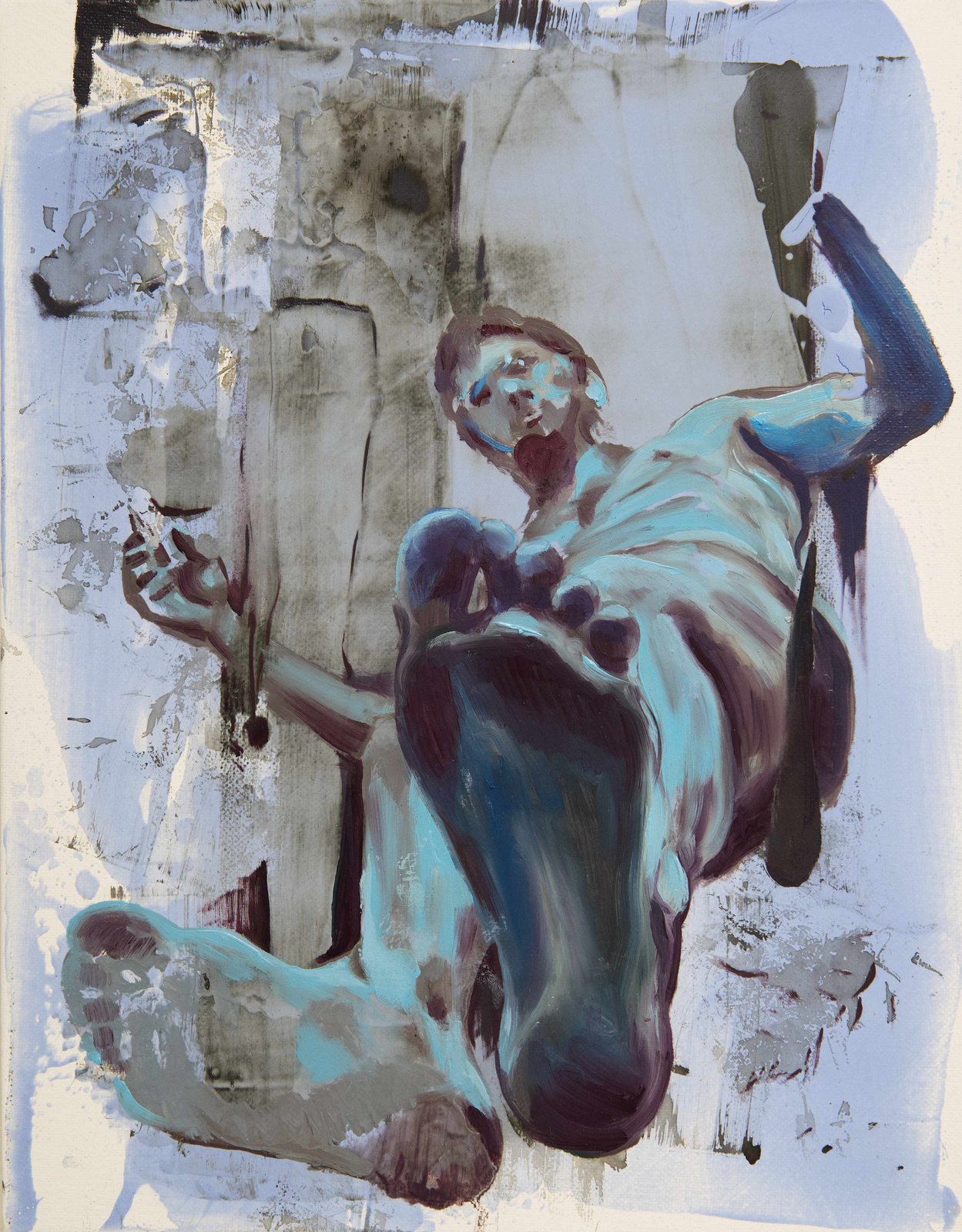
In July 2026, I started a painting that broke my own pattern. It was a large canvas, square in shape, oil on canvas. The figure in it was seen from the feet. Not from the front, not from the side, but from below, the way you see a figure when you stand under it and look up. That painting became the first work of a new series. I called the series Apogee.
The word means the highest point. The climax. The point of furthest reach. It is the right word for these paintings, because the foreshortened figure is the figure at its most extreme. The feet are close and enormous. The head is far away and small. The whole body is stretched between those two points, and the painting has to hold that stretch without breaking.
The idea came from Italy. In May and June of this year I spent five weeks there. I visited Rome, Venice, and Florence, and I stayed in Orvieto. In all of those places I stood in front of the great masters. Raphael. Michelangelo. The Sistine Chapel in the Vatican. I was impressed by all of it, and I have been impressed before. This was the third or fourth time I have seen those works. Each time I go, I think about bringing something from them into my own paintings.
What stayed with me this time was the ceilings. The fresco figures on the ceilings are painted foreshortened, with correct perspective, so that we look into a deeper space in the ceiling rather than at an empty, flat surface. The figure does not lie on the ceiling. It opens the ceiling. That is what I wanted to explore. Not the stories those figures tell, and not their style. The device itself. Foreshortening as a way of pulling the viewer into the painting instead of leaving him standing in front of it.
So the work began with my own body. I photographed myself in foreshortened poses, to have reference photographs for the perspective. That also let me think about the composition before any paint was involved. It gave me a starting point for the first painting, and then for the series. The pose is mine. The painting is not a self portrait. The body is a structure, a piece of architecture to be built in paint.
Before Italy, I had been working on the Mirage paintings for almost a year. Mirage started during my art residency at Angelo State University, funded by the Edwards Trust, and it was mostly abstract landscape, based on the landscape I saw in San Angelo. When I came back from Italy I continued with Mirage, but I knew I needed to start something else, something fresh, to break out of that pattern. I wanted a different pattern of paintings and shapes in my work. Most of all, I wanted to go back to the figure.
Apogee is that return. The series now holds ten paintings, which I call Fragments. The first six are small. Fragments 01 to 04 are 14 by 11 inches. Fragments 05 and 06 are 8 by 8 inches, oil on rabbit skin glue and canvas. The last four, Fragments 07 to 10, are large, 48 by 48 inches each, oil on canvas. The small paintings are where the idea was worked out at close range. The large ones are where it stands at full height. Seen from the feet, a figure on a canvas that size does not describe a person. It towers. That is the fresco lesson, learned at studio scale.
Two of the small paintings have already traveled. Fragments 05 and 06 were shown in October 2026 in Belgrade, Serbia, in the group exhibition The Eight Art Encounters at the House of King Peter I Cultural Center. I wrote about that exhibition in Two Apogee Paintings in Belgrade.
In my statement for the series, I describe these paintings as abstract figurative works of foreshortened figures seen from the feet, painted directly, with aggressive brushwork, in the spirit of the Italian frescoes. Aggressive is the honest word. A foreshortened figure does not accept cautious paint. The proportions are already extreme. Timid brushwork would apologize for them, and the painting would collapse into a trick. The brushwork has to be as direct as the drawing underneath it.
The series is still growing. I do not know yet how many Fragments it will hold, and I am in no hurry to decide. A series ends when it stops asking new questions. Apogee is still asking.
All ten paintings can be seen on the Apogee series page. The paintings are listed in my store.


